GVUL Experiment October 2024 Update (Part 5)

Did you notice that I forgot to check my balances and obsess over my GVUL investments on September 1st? I did, but not until nearly the end of the month. I’m proud of myself for that.

By now screwing around with these investments I didn’t risk making a stupid short-term move on what I intend to be a long-term investment. Would you be surprised to hear that me looking at these investments (or not looking) appears to have zero impact on their performance?

(If you’re just joining us, this is the latest update on our GVUL Investing Experiment.)

So how did we do for the past two months?

Overall, I like what I’m seeing. It’s been less than a year and I’m already up a minimum of 5.52%, with my best performer up nearly 9% before tax. That passive index fund with miniscule fees of just 0.015% still leads the pack at 7.04% ROI, even accounting for top-tier capital gains tax.

I can’t pass up the opportunity to point out that the outrageously expensive fund run by a bunch of 50-pound brains at BlackRock is currently the worst performer in this group. This continues to prove the S&P’s data saying that most actively-managed funds fail to perform as well as the market overall.

This experiment is too young to conclude whether the BlackRock fund’s performance is better or worse overall. However, as a cheap shot, we can project the values of these investments into the future. If that BlackRock fund were to continue only earning 5.52% per year, when I retire in just over 20 years it would be worth $2,928.28. However, if FXAIX continues at 7.04% per year (an after-tax return) it would be worth $3,895.81 in 20 years. The fancy, expensive BlackRock fund would be worth a full 33% less than my passive, low-fee index fund, even with its massive tax advantages.

I don’t know how this will actually turn out, but at this point the very expensive GVUL investment scheme has failed to prove its value.

Unused Basis

Note that if I cashed out my GVUL investments right now, I’d pay zero capital gains tax on them because the IRS allows my company’s insurance premium payments to increase the basis of my investments. Though cool, I can’t help but notice that my unused basis continues to increase. This means the company is paying more in insurance premiums than my investments are gaining in value.

This isn’t a problem, per se. However, if the trend continues I could potentially end up leaving lots of premium payment dollars on the table. I don’t love that. I hope compound interest kicks in on those investments soon!

How Much is Enough?

I dedicated an entire chapter of my book to asking this question: “How much is enough?”

Does it matter that much whether my investments are making 5.52% or 7.04% after tax?

No, it truly doesn’t. If you want to debate me on that, I’d love to go against you over some frosty beverages on my next layover. I’ll be in Denver and Bozeman later this week. Hit me up!

Let’s step beyond the scope of our experiment and say that instead of investing $1,000 as a round number, we’re talking about an overall investment balance of $1,000,000. (Yes, if you apply Pilot Math in your life you can absolutely reach this with at least 20 years remaining in your career.)

We’re splitting hairs between ending up with $2.9M and $3.8M after 20 years. Is that difference significant? Sure. However, I believe that most pilots could put a Treasure Bath of $2.9M to excellent use helping them live a wonderful life. Would a pilot’s life be significantly better with an extra $900K? Maybe if they bought a share in an F4U. Otherwise, I don’t think it’d make that much difference.

A balance of $2.9M is enough to provide $116,000 in annual passive income for at least 30 years, if not generations after you die. If you can’t live a great life on that amount of spending, you’re doing it wrong.

I assert that each of us has better things to do in life than obsess over percentage points in our investments. Is it okay to seek ways to optimize and improve investment performance? Sure, as long as you’re enjoying other parts of life too.

Enjoying Life

I forgot to check on my investments at the start of September in part because there have just been so many better things to do in life.

My kids started school, and I’ve enjoyed things like watching my daughter run cross country races.

Girls JV Cross Country

I ran cross country back in the day. I was never very fast, but I enjoyed it. I’m proud and happy to see that my daughter is learning to enjoy a healthy pastime that I also love.

My son opted to continue doing virtual school this year. As of October 1st, he’s nearly finished with several of this semester’s classes. Some of those are high school classes he’s taking as an 8th grader. We’ve supplemented his education by setting up a Minecraft server on an old PC, and I signed us both up for a course in Python programming using Raspberry Pi computers. He’s going to be lightyears ahead of his peers when he gets to college, and he’ll be able to use our college savings to help pay for a PhD program, instead of wasting that money on Gen Ed classes. Thank goodness he got some smartypants genes from his smoking hot mom!

I’ve also gotten to do lots of fun flying. One student just earned her Glider Flight Instructor rating (CFIG). During training I realized that of roughly 200 hours in my Pipistrel, I’d only spent a couple in the left seat until recently. I always put my father-in-law, wife, kids, friends, or students in the left seat, so I even sit right seat when I fly solo. It was weird to get back into the left seat. It was also lots of fun playing bad student!

Manatee Airport (48X) is a great place to play “bad student.”

I also got to finish an insurance checkout for a neighbor at my local airport. He bought a gorgeous Piper Vagabond over a year ago, and has needed 15 landings and a few hours for insurance. Between living out of state and a couple maintenance squawks, he hadn’t been able to fly solo or take it home. I thoroughly enjoyed flying a classic aircraft as we finished up his requirements!

There’s nothing wrong with a Cub, but I sure had a great time flying this old PA-17!

I also recently gained the privilege of helping sponsor a Fairchild PT-19 new to the CAF’s Tampa Bay Wing. We took over stewardship for this beauty way back in June, but only had one pilot qualified to fly her.

Come fly the PT-19 with us. It’s as much fun as it looks!

After several months of waiting for paperwork to stack up high enough, I got to spend a day at Airbase Georgia flying their PT-19 with a living legend of aviation, Major General (Retired) George Harrison.

I’d just finished reading Fighter Pilot (Robin Olds’ biography) and mentioned it to my instructor. He said, “Oh yeah, I flew F-4s with those guys in Vietnam. They were great. I got my Mission Commander qualification as a First Lieutenant one time when I was flying #3 on a mission with Chappie James. He had to drop out, so I became MC by default. I made it back that day, so I got to continue flying as mission commander from then on. That was pretty cool for a young lieutenant.”

#AmericanBadass

That was just the tip of the iceberg on his combat experience in Vietnam. He was a great, easy going instructor and kind person. What a treat it was to spend a day and fly with him!

This might be the nicest PT-19 on the planet.

Airbase Georgia’s PT-19 was in tip-top shape, and flew wonderfully. As much as I enjoyed it, this was one of the less-exciting aircraft in their hangar.

Are you as jealous as I am?

My visit to Falcon Field took place on the way to a work trip. Almost as soon as I got back, my home unit put me to work. I got to spend yesterday checking out another pilot in our PT-19. We now have 3 qualified pilots. The other two will be instructors soon, and we’ll be building up to a cadre of at least a dozen pilots. We’re planning to give rides and attend airshows, and I’m looking forward to all of it.

It’s tough to beat instructing from the back seat of a tandem, open-cockpit WWII trainer.

Not to be outdone by airplanes, my wife got us tickets to see Edwin McCain, Collective Soul, and Hootie and the Blowfish for Hootie’s 30-year reunion tour. She isn’t always into the crowds and overdone volume of big concerts, so it was a special treat to spend the night rocking out with her.

I’ll be doing pretty amazing if I look half as ripped or sound one tenth as good as Darius Rucker when I’m his age ten years from now. That man can sing!

Be Excellent to Each Other, and…

I don’t post all of this to brag. I hope it helps make the point that you and I all have better things to do than obsess about the minutiae of our investments. That’s the beauty of passive investing and passive income.

Invest as much of your income as you can stand in low-fee index funds. Set it, forget it, and move on to better things!

The market will experience dips and bumps along the way. However, as long as you aren’t spending like a moron and you invest as much as possible, you almost can’t help but succeed. Focusing on living a fun, balanced life with your family helps make that happen.

See you for another update in a month, or two, or something.

GVUL Experiment August 2024 Update (Part 4)

I blinked, so July is over. I’m proud to say that after writing last month’s update to this little GVUL investing experiment, I didn’t check my investment accounts again until just now. We get some surprises and interesting takeaways. I’m also going to talk about some of the things I did other than checking my account balance last month. (You can skip that part if you want.)

First, the numbers:

Hello Volatility!

Last month, our fancy BlackRock fund had increased more than $49 in value. This month, that value decreased by $28.84, making our overall holdings in that fund worth less than they were last month. Ouch.

That BlackRock fund comes with the highest expense ratio in our experiment: a staggering 0.63%. The idea is that the big brains at that swanky investment firm earn that extra cut of our earnings by choosing so well between winners and losers that they can beat the overall market.

If you’re here, then you probably have enough financial education to realize that this isn’t realistic. Most actively-managed funds under-perform the overall market in the long run. This month’s results illustrate that perfectly.

Despite leading the pack last month with a 4.93% return, this month our BlackRock fund’s overall ROI now lags both of our low-fee index funds by 33%!

I’m also thoroughly unimpressed by our actively-managed “S&P 500” fund that doesn’t actually try to match the S&P itself. It’s up less than half as much as its passively-managed, low-fee competitors.

Now, if we judged any of these funds based on a mere two months’ performance, we’d be fools. This is a long-term experiment because investing in the market only works over the long term.

This type of volatility is what a lot of investors mistake for major risk. Let’s touch a little more on that idea.

Risk vs. Volatility

Uneducated investors see the fact that the market can swing wildly up or down in a short amount of time and think that’s a big risk. If you’re investing properly, for the long term, these short-term changes are meaningless.

Sure, if you retired yesterday and need your money right now, then today’s market performance matters some. However, if you plan ahead enough, you can plan your withdrawals ahead of time and avoid issues. Over the very long run, the average return of the overall stock market is 10.5%. If you can embrace the idea of “fire and forget” with your investments, you’re likely to approach that return over time.

The people who get worked up about volatility are mostly day-traders who need to avoid big downturns right after they buy. You can play that game if you want to, but I think it’s a waste of time for most pilots. Go fly something cool instead.

For me, bigger risks are things like an entire company losing their way. (See: Boeing, Twitter, and many others lately.) The value of those companies decreases because they make bad decisions. We diversify our investments to avoid this type of risk. That leads to a quick discussion of diversification.

Diversification is About Risk, Not Return!

Just about any financial advisor will urge you to diversify your investments. Uneducated investors somehow get the idea that this is about getting better investment returns. That’s dead wrong!

An investor would always get the best possible returns by picking the one single company that is going to perform the best over their time horizon, and put all their money into it.

I recently listened to a fantastic episode of Paula Pant’s Afford Anything podcast with Michael Kitces as her guest. (If you haven’t already, listen to it!)

Paula Pant is a fantastic writer, thinker, and podcaster. You should spend some time listening to and reading her work!

Their discussion suggested that the best possible investment in the recent past probably would have been to buy stock in Nvidia. This stock has performed wonderfully because their GPUs are key components for both AI and cryptocurrency.

However, what if Intel, or Google, or AMD, or someone else suddenly announced a much better GPU, at a lower price along with the ability to manufacture them twice as fast as Nvidia? That high-flying stock would crash overnight, and AMD would be the new hotness.

If we diversify by buying both Nvidia and AMD (and Intel and Google) we get the gains from whichever one wins, while also absorbing all the losses. That sounds bad, but in the long run this is exactly what gives us that 10.5% average return for the whole stock market.

We diversify because we’d rather only get a 10% return than suffer the massive losses of picking a winner that suddenly becomes a loser (or worse, picking a loser than looked like it would become a winner when we bought it.)

Why do I talk about this over and over again? I feel like a lot of Certified Financial Advisors convince us to pay them extra to help us diversify our investments because (they convince us) it’ll increase our overall returns. That’s wrong in every possible way. If a financial advisor starts trying to sell you on this, please politely shut them down.

Paying a CFP to diversity your holdings won’t increase your returns, and you don’t need someone to pick stocks to help you diversify. There are plenty of passive, low-fee index funds available for this. Those index funds help protect you against volatility or the risk of any given company suddenly failing. You don’t need to pay someone else to help you mitigate those risks either.

Tangent – Actual Investing Potential

That same episode of the Afford Anything podcast includes its own excellent discussion of why pilots like us should not bother trying to pick stocks ourselves. Basically, Kitces asserts that since most pros who spend all day every day trying to pick stocks usually fail, it’s nearly impossible for a lay investor to do better. However, unlike a hedge fund cubicle dweller, a pilot like you or me does have the ability to pick up an extra trip, frequently for premium pay, and make a bunch of extra cash for very little time or effort invested.

For a major airline Captain in my position, a day of flying for premium pay is worth a minimum of nearly $4,500. That day might cost me 24 hours away from home, including 2-14 hours of actual work. Overall: not too shabby.

I could, instead, spend 2-14 hours researching stock picks while sitting at home. What is the chance that I could end up learning enough in those 2-14 hours to make a meaningful investment decision capable of generating $4,500 in one day? I’d say that chance has a value approaching zero. The chance that I could do this more than once, without accidentally picking a bunch of losers in between two wins is even lower.

I do think some alternative investments offer different benefits, risks, and tax advantages that make them worth researching. They are not stock picks, and we’ll discuss them another day.

At the very least, picking up an extra day of flying likely has a much higher ROI than almost any stock pick. I sincerely hope that most of us have other important things to do as well. I’ve had a busy July that didn’t involve much work flying. However, it was both fun and rewarding. I want to chronicle some of it here as an example of a better way to spend time than trying to pick stocks.

If you don’t want to read about personal, non-financial details, you can skip the rest of this post. Thanks for reading, and I’ll see you next month.

Better Ways to Spend Your Time

I do a lot of GA flying out of a great little grass strip officially known as the Historic Wimauma Auxiliary Airfield, FD77. It’s a truly fantastic place with good people and cool aircraft. We’re big on mentoring future generations, and two of our favorite young people are Lorenzo and Christian. A friend recently sponsored the cost of Lorenzo’s Private Pilot ASEL rating. I figured that since my Pipistrel is a glider, I could do the same for Lorenzo’s Private Glider add-on, and Christian’s initial Private Pilot Glider.

I got to enjoy several days of flying with two great young people who actually study before showing up, pay attention to what I say, and even offer to help wash the plane when we’re done. I had Lorenzo soloed on Day 2, and he passed his checkride with flying colors later that month. Christian is doing well and should solo soon.

Young Lorenzo on his glider solo.

Next, I flew with a paying customer who traveled all the way from Europe to get his initial Private Pilot Glider rating. He’s a sharp business owner who also did well on his checkride the same day as Lorenzo.

I enjoy flying and teaching any time, and will take just about any excuse to do either. The fact that this particular student generated enough revenue to at least cover the costs of hangar and insurance for the month was icing on the cake.

I didn’t spend all my time flying this month. My wife and I got to spend a weekend away from the kids. We didn’t go too far, but I cashed in the Marriott points to score a $700/night room at the Ritz Carlton Sarasota for very little out of pocket cost. My wife was thoroughly impressed. If you haven’t been, Sarasota has some fantastic food downtown.

We also had a scary incident this month. One of our pups, Subzero, suddenly started having a hard time breathing. I spent essentially a whole day waiting to get him to an emergency vet. He spent the night there, and we spent the day after he got home watching him closely.

Thankfully, the vet’s treatment was successful. SZ is happy as ever and fully back to normal! He recovered from that visit much more quickly than our wallets will.

Although I complain about the costs of that vet care, I feel blessed to have a great job at a great airline. Since my wife and I have had the good sense to fill up a Treasure Bath, covering this bill didn’t break us. Also, as an airline pilot I get to spend enough time at home that I was actually able to be at home with my family for this emergency.

If I was at a lesser company, or worse, in the military, I might have had to ditch my wife and say, “Sorry the dog’s sick; take care of it yourself.”

Having great jobs and a Treasure Bath has also paid off for us another way. We’ve talked for years about building a dream house with things just the way we want them. After a couple years of shopping we found a great opportunity to do just that.

Yes, my children insist on dressing themselves. Yes, I frequently offer to buy them clothing that fits. You can lead a horse to water….

We’ve since spent many hours choosing options and finishes, and planning the other enhancements we’ll do ourselves after our builder is finished. (Among other things, we’re hiring our own contractor to do a massive solar array and electric car charger. Since we live in Florida, we’ll truly get to drive that vehicle on nothing but sunshine and sell any excess power to the neighbors.)

Our new house will be closer to our kids’ school, my wife’s job, and is no further from Wimauma AAF. It’ll have almost everything we’ve spent these years dreaming and saving for. We were able to move quickly with the deal in part because we had plenty of Treasure available to scoop from our bathtub to cover our down payment.

Last, but Not Least: Oshkosh!

If you’ve never been before, you must find a way to attend the EAA AirVenture at Oshkosh sometime. I’ve been there a few times, and this year I got to fly my Pipistrel to the show for the second time.

Some weather deviations made this trip just over 25 total flight hours.

My trip was not without hickups. I stopped for fuel in Cross City, FL, to find my nosewheel covered in oil. Some tight clearance between my filter and my fancy Akropovic exhaust doesn’t leave enough room for a conventional filter wrench. I’d crimped the casing of my filter using the least terrible wrench in my toolbox, and it failed on me.

No, your other filter wrench won’t fit. I promise. I tried them all.

Thankfully, I was close enough to home to get new parts and do a replacement on the ramp. I enjoyed the rest of my trip to KOSH, and finally found the correct filter wrench at the Lockwood booth at the show.

The wrench is from Lockwood. I just happened to be waiting to speak with the Dynon reps about my panel when I took the picture. Endorsement of both excellent companies entirely intended.

AirVenture had some great acts and some exciting new aircraft on display. I had the honor of giving a presentation about getting higher quality flying for less cost at the National Association of Flight Instructors display on Wednesday. I received positive feedback, and hope to continue spreading that message.

One of the best parts of the show this year was that a few friends from Wimauma also flew up. Three of them were there for their first time, and I enjoyed seeing the magic of Oshkosh reflected in their eyes. They had their own challenges getting to and from the show, so we didn’t get to park together. I ended up at the far end of the South 40, with some interesting neighbors.

King Air vs Pipistrel, pretty opposite ends of aviation. I think they burn more fuel in an hour of flying than I did on this whole trip. They did bring a palatial tent, a full kitchen setup, and 4 people.

This didn’t prevent us from enjoying the afternoon shows from their prime location in the North 40.

The Wimauma Five at sunset.

Somewhere amidst all of this I managed to do some airline flying and even record an episode of the Engage podcast with my MEC Chairman in Atlanta. It was a busy month, but all time well spent.

I could have used some of those days researching stock picks, but I think it would have resulted in an overall loss. My investments in FXAIX and VTI are up 3% in two months, which is outstanding. Why not fire-and-forget my Treasure into great investments like that and spend the rest of my time flying, teaching, hanging out with friends and family, and taking care of my sick doggie?

I’d love to hear your thoughts on this. Do you spend lots of free time researching investments? If not, what other valuable ways do you spend your time? How much money does it take to convince you to pick up an extra day of work?

GVUL Experiment July 2024 Update (Part 3)

Welcome back aviators! Today is the first monthly update in our GVUL Investing Experiment. If you want a refresher on what that experiment entails, start reading about it in Part 1 here. You can also see our initial conditions in Part 2 here.

Let’s start by being honest with ourselves: one month’s performance here is next to meaningless. It’s far too early to draw any conclusions. It’s not even fair to assert a trend. That said, this month produced some interesting data. Here’s the summary of my positions today.

BlackRocket!

First off, let’s note that our BlackRock fund beat the pants off everyone else with a 4.93% ROI in one month! This is more than double the next best fund (FXAIX). If you project that to continue for 12 months you’re looking at a 59.16% annual return! Wow, right?

No.

If you look at the history of this and many other BlackRock funds you’ll see that some years they vastly out-perform the market while others they double the losses suffered in the market overall. Remember: most actively-managed funds under-perform a passive, whole-market index fund.

As Chancellor Palpatine once told his protege, we’ll watch this fund’s career with great interest. However, we aren’t going to project, conclude, or expect anything without a lot more data. (And even then, past performance is not an indicator of future returns.)

Basis Advantage

The next thing we should note is that the cost basis of the GVUL investments has grown faster than the value of those holdings. This means that Delta has paid more in life insurance premiums on my behalf since I signed up for the GVUL that I’ve accrued unrealized investment gains.

And that, my friends, is the true strength of the GVUL.

This means that if I were to cash out all of my investments, I would pay zero capital gains tax on my earnings. In fact, there is still $152.84 in insurance premiums being counted toward the cost basis of my GVUL investments that isn’t even spoken for yet. I expect these investments to gain enough value to more than eclipse those premiums. However could take some time.

The fact that my more traditional investments would be subject to a 20% capital gains tax (assuming worst-case…Captain’s pay is high) cost me up to 0.6% this month. This effect shouldn’t be so large going forward, but that helps assign a quantifiable value to the GVUL being able to count insurance premiums toward investment basis.

Falling Short

Although my BlackRock fund beat the other three horses in this race, my other GVUL fund, the MetLife Stock Index Fund, finished last. It has some of the lowest fees available, so I had higher hopes for it. So far, it’s a weak start.

Also interesting was are the differences in performance in my three bottom funds. The MetLife Stock Index Fund targets the S&P 500, and FXAIX is a more honest S&P 500 index fund. It seems odd that in a single month, FXAIX would more than double the performance of its peer. However, we know that the MetLife isn’t actually an index fund. Its background materials freely admit that it only attempts to match the performance of the S&P. That’s a big difference.

We should also note that for this month our Total Stock Market ETF, Vanguard’s VTI, did a full percentage point lower than the S&P 500 fund I picked. We should expect these to differ some.

I think it’s too early to decide whether any of this means anything though. I’m looking forward to seeing how this experiment unfolds. And now, I’m going do to my best to completely ignore these investments until next month. See you then.

GVUL Investing Experiment Initial Conditions (Part 2)

After way too much effort, we finally have our initial conditions set up for our experiment.

After writing a check and using USPS to send it to MetLife, I logged in to my GVUL account every couple days for about a week. Although they didn’t send me any kind of confirmation or notification, my money suddenly showed up in my investing account one day:

Sorry for the clunky screenshot. MetLife’s way of displaying this information is…well…clunky.

You’ll notice right away that although I sent them exactly $2,000.00, I only have a total of $1,955.44 invested. That’s because MetLife charges us investors a “front load” of 2.25% any time we deposit money. My calculations how that they actually only charged 2.228%, but I don’t count the difference as a big win.

Since I start off at a penalty, the market has to go up 2.279% just for me to get back to my original value of $1,000. And that doesn’t account for the large expense ratios these funds charge.

I would have liked to submit the orders for my Vanguard and Fidelity investments on the same day as the GVUL; however, MetLife’s clumsy system meant I had no way of knowing when that money would actually reach my account. So, as soon as I saw my GVUL balance I ordered $1,000 of VTI with Vanguard:

and $1,000 of FXAIX with Fidelity

The Vanguard investment shows my value at $999.68 because the market dropped slightly from the time I submitted my order to the time I took my screenshot. My Fidelity investment shows $1,000.04 which means the market went up just a little.

From this point we do the most important thing in investing: we wait. Patiently.

Remember: when Fidelity investigated to see which of their investors got the best returns they found that dead people beat everyone else because they didn’t constantly mess around with their investments like their living counterparts.

We’re going to emulate these investors by only checking in on our investments about once a month (or less if I’m too lazy to write about it). The goal here is to show whether MetLife’s fees have an outsized effect on invested dollars, and if so how large that effect might be.

That said, we can put some of our time to good use. I managed to find a treasure trove of background information on the GVUL investments.

GVUL Fund Source Data

For starters, I found some info about GVUL investments on the SEC website. It’s worth reading, but not while you’re flying because it’ll put you to sleep.

From there, I ended up finding the page on the MetLife website with prospectus, annual report, and other information for all of our investing options. Although this page looks very simple, it links to thousands of pages of documents. Digging in to some of that information did not leave me particularly impressed. The most telling thing I found was this chart, from page 6 (labeled “BHFTII-2“) of the Brighthouse Funds Trust II
MetLife Stock Index Portfolio’s Annual Report:

Remember: this never purported to be an actual S&P 500 index fund. The background information for this investment states that it’s an actively managed fund with the goal of approximating the performance of the S&P 500.

This chart freely admits that over the long term, this fund fails to perform as well as the index it aims to track. I don’t even have to beat the dead horse by reminding everyone that the vast majority of actively-managed funds fail to perform as well as the market overall. With this chart, MetLife pulls a President Karpov and says: “I do not deny it. I proudly admit it!”

Not only does MetLife admit that their fund failed to meet its stated goals over the last 10 years, they charge their customers (us) a 0.27% fee…every year…for the privilege of failing so openly with our money.

Hmm.

Digging further into the source data is fascinating, if you can keep your eyes from glazing over. Starting on Page 8 of the Annual report (labeled “BHFTII-4“), we get a detailed list of the specific things in which this fund has invested.

To be fair, most of the investments here are exactly what I’d hope to find in something aiming to match the S&P 500. The list shows that 99.3% of the funds assets are invested in common stocks from companies that make sense: Dow Chemical, American Express, Walmart, Honeywell, etc.

However, toward the end of this section we find some weird stuff.

This fund has:

  • Nearly $10M invested in US Treasury Bills
  • More than $44M in CDs at banks all around the world.
  • Over $37M invested in other mutual funds, including one each at BlackRock and Fidelity
  • Much more

These alternative investments only account for 0.7% of the total assets in which this fund is invested. However, we have to wonder: Why?

Part of the reason is that the fund needs some quickly-accessible assets in case a large number of investors want to cash out. That’s fine with me because someday I’ll be one of those investors. (Yes, a CD or a corporate loan isn’t necessarily a liquid investment. The must be part of some other strategy….)

It takes a lot of expertise, research, and administration to find and execute some of these investments at all, let alone to make money from them. If you’re wondering where your 0.27% expense ratio is going, the answer is into the pockets of the fund managers who get all this done.

The annual report showed the net assets for this fund at $7,439,153,437. An expense ratio of 0.27% means that this fund’s managers make more than $20 Million, per year, for failing to meet their stated goal.

This wouldn’t be a bad thing if MetLife’s fund performed well enough to at least equal the performance of the S&P 500, after accounting for their 2.25% front load, their 0.27% expense ratio, and other fees. However, we just saw the chart showing how that isn’t the case.

I’ll spare you a deep dive into the source documents for the BlackRock fund we’re using in this experiment, but you’re welcome to take a look for yourself.

Why Bother?

Are you tired of me complaining about the GVUL investment setup yet? I’m not going to stop, but I will at least say that even with all these drawbacks this investment option might be worthwhile.

Let’s recall that I built a calculator to compare investing in the GVUL to investing the same amount of money in a regular brokerage account. You can download your own copy here. (Yes, a copy. Don’t ask for permissions to edit the master.)

When I initially wrote about the GVUL I showed that, even despite all these crazy fees, investing through the GVUL still appears to be mathematically advantageous in many cases.

This isn’t true because the GVUL has good investment options or low fees. It’s true because the insurance premiums paid by Delta Air Lines get counted as part of the basis for your investments. By my math, Delta will pay at least $250,000 in insurance premiums over the course of the average pilot’s career. That could mean you get a quarter of a million dollars of investment gains completely tax free.

Before you invest in the GVUL, you should consult with a Certified Financial Advisor. When you do, they’ll probably take one look at the fee structure and say, “No way!”

If they do, ask them where they would invest your money instead, and what fees they charge.

Many advisors will do what the Brighthouse Funds Trust II MetLife Stock Index Portfolio does and spread some of your investments among a bunch of mutual funds and ETFs. This means you’re probably paying your CFA upwards of 1% per year to invest your money in mutual funds that charge an additional expense ratio.

If I have to pay a high expense ratio anyway, I’d rather pay a one-time 2.25% fee up front, rather than an ongoing 1% fee every year. I hope you don’t need a fancy spreadsheet to tell you which of those fee structures is worse.

If you’re paying an advisor who charges you an annual fee based on Assets Under Management (AUM), you should understand that they’ll be inherently biased against any investment outside of their control.

Every dollar you invest with the GVUL is a dollar on which they can’t charge you their annual 1% fee. They’ll note that the MetLife fee structure, or the funds’ performance, or a variety of other reasons make GVUL investing a sub-optimal deal, and they’ll be right. However, at least some of the underlying reason for their argument may very well be their natural drive to get as much of your money included in their Assets Under Management.

I can’t blame professional advisors for gravitating toward getting all of your investments under their control. Most of the big players in their industry require them to operate under the AUM model. Most pilots need professional help for things like finding tax advantages and setting up a comprehensive estate plan. It’s okay to invest some of your money with them and pay their fee if that’s what it takes to get their services. However, there’s no need for them to “manage” your 401k, TSP, GVUL, MBCBP, or other investments. You can manage those effectively on your own.

The better model here is fee-based financial planning. You pay a pro a one-time fee to look at your situation and advise you on an investing strategy. This might cost you a few thousand dollars. However, once your plan is in place, you just keep using it as time goes on. You can also hire a fee-only financial planner to help with tax issues, estate planning, etc. I haven’t found a good one to recommend yet, so I’d love to hear recommendations if you find one.

It’s also fair to note that many of us pilots can be both cheap and short-sighted. If we speak with a fee-only financial planner who wants to charge us a one-time fee of $3,000 we balk. Instead we see a “measly 1%” AUM fee and think it seems smaller, especially early in our careers. If paying that fee gets you investing the bulk of your income and gets you specialized help for tricky parts of your overall finances, then I’d rather you pay 1% than not get any help at all. Just know there are other options.

Your Certified Financial Advisor should be okay with you managing some of your own investments and not pressure you to put absolutely everything under their control. If they start to get pushy, push back a little. If they don’t back off, find someone else.

An even worse situation under the AUM model happens if your agreement with your advisor considers them as “managing” any money you invest in the GVUL because they tell you which funds to pick. Then, since that money is part of their AUM, they’d charge you their ongoing 1% fees, on top of MetLife’s 2.25% front load, and the individual funds’ expense ratios.

Please don’t ever sign a contract agreeing to this. If you’re currently in a contract like that, start shopping for a different advisor. I promise you can do better.

Summary

I got my money invested and the experiment is running! Initial balances are:

  • Brighthouse Funds Trust II MetLife Stock Index Portfolio: $977.72
  • Brighthouse Funds Trust II BlackRock Capital Appreciation Portfolio: $977.72
  • FXAIX: $1,000.04
  • VTI: $999.68

Looking into the source data for the MetLife funds was a little scary. They freely admit they fail to achieve their stated goal, and we reward that by paying them $20M per year. Some of the investments in that fund have nothing to do with the S&P 500 at all.

Despite this, we must remember that the whole reason for GVUL investing is that Delta’s life insurance premiums allow us to enjoy thousands of dollars in tax-free investment gains.

Certified Financial Planners won’t want money invested in the GVUL for a variety of reasons. However, one reason might be that if GVUL investments don’t count as part of their Assets Under Management, they can’t charge you their own annual fee on those dollars.

You do need to speak with a CFP before investing in the GVUL. Do your homework. Run my calculator for yourself before taking the results to a Fee-Only Financial Planner, if possible, or a regular CFP who has a fiduciary duty to not talk you out of this if it is a good deal.

Despite all the reasons to not like GVUL investing, the math says that it is a good deal in many or even most conditions.

We’ll aim for monthly updates in hopes of supporting or contradicting that theory as our experiment continues.

Thanks for reading!

Thanks to Talha Hassan on Unsplash for this week’s feature image!

GVUL Investing Experimental Comparison (Part 1)

Delta recently started offering their pilots a new type of life insurance: a Global Variable Universal Life (GVUL) policy. This policy has some intriguing new options for pilots to invest their money. I’m going to run an experiment to determine whether the potential benefits of GVUL investing outweigh some significant drawbacks.

You should refresh your memory on GVUL basics by reading two posts I wrote about the policy (here and here).

The two key advantages of this policy are:

  1. Unlike the legacy term life insurance plan, most of the premiums that Delta pays into the GVUL on behalf of the pilot are not counted as imputed income. This represents a big tax savings for every participant.
  2. The GVUL has an attached, optional, investment account. It’s not a very good way to invest, but government policy allows insurance premiums paid by Delta to offset gains from GVUL investments. Over the course of my career, this should represent roughly $250,000 in tax-free investment gains!

These advantages come at some significant costs:

  1. The GVUL only allows investments from a very limited menu of funds. Most are even actively-managed funds (barf!)
  2. MetLife (the GVUL provider) charges pilots a 2.25% fee, called a “front load,” on every dollar invested. The domain of shady Wall Street wolves of the past, front loads of any percentage are virtually unheard of in modern retail investing. This fee is a bad deal.
  3. The investment fund options on the GVUL menu each charge very high ongoing fees themselves. These expense ratios range from 0.23% to 0.63%. While those might seem small, they’re at least 16 to 42 times higher than the 0.015% fee available for excellent, passive, broad-based index funds available in the Delta pilots’ 401k plan. In fact, the Delta pilots have access to FZROX, a zero-fee total market index fund. MetLife’s fees are unreasonably high.

There are even more drawbacks to the investing side of the GVUL, but let’s focus on moving forward.

Harnessing Collective Bargaining

The first way I started addressing the drawbacks of GVUL investing was to write a resolution for my union council, Local Executive Council 66 of ALPA’s Delta MEC. My resolution noted that getting the GVUL was a great victory overall, but highlighted the shortcomings noted above and directed the union to work on ways to eliminate or mitigate those problems. I even suggested some concrete fixes.

My resolution passed with flying colors at a recent LEC meeting and will be carried up to the MEC for inclusion in our overall negotiations with the company. I’m not holding my breath, but it does seem like a straightforward ask.

Devising an Experiment

In the meantime, I figured it might be informative and entertaining to conduct an experiment that should illustrate my concerns.

I decided to invest some money using the GVUL, while investing the same amount of money in a more traditional (and drastically lower-fee) brokerage account as a control group. I planned to leave the money invested for a year, reporting irregularly (because I’m too lazy and/or busy to post consistently) on the progress of each pot of money.

I figure that over the course of a year, we should be able to see the effects that MetLife’s fees have on investment dollars.

So, I logged on to MetLife’s GVUL website to transfer some funds and start my investment. Are you surprised to hear that things started going haywire right away?

What Century Are We In?

It took a lot of clicking to find anything about my GVUL investment options. I throw MetLife a bone here. They’re not normally a customer-facing investment firm…they’re a life insurance company. Still, it was frustrating that I had to dig so hard to find what I needed.

When I finally got to a menu that gave me the option of making a lump-sum deposit (because there’s no way I’m doing monthly payroll deductions yet) I got the oddest message:

Yes, MetLife instructed me to mail them a check, promoting me to ask myself: “What century am I in again?”

Baffled, I clicked around the website for another 10 minutes before giving up, picking up my phone, and calling the customer service number. I didn’t like many of the answers I got, but you’ll see shortly why I’m so glad I called!

Thankfully, the phone tree at the number provided had pathways specifically for pilots from my airline, meaning I got to a human far more quickly than when I call USAA or try to reach the schedulers at my airline.

The nice lady confirmed that, yes, I did need to mail in a check to invest money in my GVUL.

Early in this conversation she gave me a surprisingly emphatic warning: MetLife charges a 2.25% front load on all investment funds!

I know ma’am, it’s so crazy! I don’t know of anyone else in the investing industry still doing that!

Honestly, I was surprised that she volunteered the information. It almost felt like the company didn’t want me investing through them.

Allocate Investments BEFORE Sending Money!

As our conversation progressed, she mentioned another critical point that narrowly averted disaster. She asked whether I’d designated where I wanted my money to be invested yet.

I replied that I hadn’t…because I hadn’t been able to get any money into my account yet. Their crazy website wanted me to send in a physical check…. At every other brokerage I use, all deposits go into what they call a settlement account, and I can only use money in that account to buy shares of equities.

She explained that MetLife’s GVUL investing works backwards (my word, not hers). You have to specify your asset allocation (on the website) before sending in your money (not on the website).

She noted that my account had the default designation for 100% of my money to go into their “Fixed Fund.” Advertised as a good deal because it guarantees investment returns of at least 1.5%, this fund currently returns something above 4%, though they don’t tell us how your money is actually invested.

With high yield savings accounts all over the internet also returning more than 4%, MetLife could safely offer a guaranteed 1.5% by doing as little as investing this money in an high yield savings account of their own. They can pass the full 4-ish percent onto us pilots, or they could return less and keep the difference.

I have zero desire for my money to sit in this fund, so I told the nice MetLife rep that I’d definitely transfer my money to some other investment once my funds got deposited…at some unknowable future point after UPS (and not FedEx anymore) delivered my paper check to St Louis.

She replied that I needed to be careful with that. It turns out that MetLife has a rule restricting us to only being able to transfer a maximum of 1/4 of our Fixed Fund dollars out of that fund per year.

Seriously?

Yes.

Again, what century are we in?

I’m sure glad I called! I would have never noticed this disastrous, and more than a little silly, loophole without the phone call. So, your first major takeaway from this post is:

If you’re going to invest money in your GVUL, log in and set your asset allocation BEFORE you send them any money!

And if you’re considering the Fixed Fund, think long and hard about the fact that it’ll apparently take you four years to get your money out of there. Don’t choose that fund unless you’re certain you won’t need your money in a rush.

GVUL Asset Allocation

The nice rep on the phone didn’t seem to have any other news to shock me with, so we concluded our call and I went to the investing menu to pick my funds.

Originally, my vision had been to invest $1000 each in two GVUL funds…the ones with the lowest and highest expense ratios. As it turns out, the lowest fee option is the Fixed Fund. (Yes, they want to charge 0.23% to to put your money into something less liquid and lower-performing than an Ally savings account.)

I think this experiment is worth accepting high fees and possibly low returns on a couple thousand bucks for the sake of amateur journalism, but even I can’t stomach this option.

So, for the lower-fee condition of my experiment I decided on the Brighthouse Funds Trust II MetLife Stock Index Portfolio. You won’t find a standard ticker symbol for this fund, because it only exists for things like GVUL investing. It states that its goal is to track the S&P 500, and it has an expense ratio of 0.26%…slightly higher than the 0.23% fees on the Fixed Fund.

Note that just because this fund aims to track the S&P 500, that does not make this a passive index fund. Financial Times notes that: “The fund normally invests at least 80% of the Portfolio’s net assets in stocks included in a particular stock index. The S&P 500 Index consists of the common stocks of 500 companies, most of which are listed on the New York Stock Exchange. It may also invest in real estate investment trusts. The advisor may rebalance the Portfolio due to, among other things, cash flows into and out of the Portfolio or changes in the S&P 500 Index.”

Basically, it’ll be difficult, at best, to know what my $1000 are actually invested in. This appears to be an actively-managed fund, meaning it’s part of the group of funds that overwhelmingly underperforms the index they purport to track. (See this article, and the source data from the S&P website supporting this assertion.)

Great.

Next, I wanted to pick the highest fee fund to see whether they earned all that extra money they charged.

I went with the Brighthouse Funds Trust II BlackRock Capital Appreciation Portfolio. BlackRock is a big name in investing, and they appear have at least 5 different classes of this fund. I honestly can’t tell which one we’re getting through the GVUL, though some information on the MetLife website seems to match this entry on Financial Times.

A friend sent me a prospectus for MetLife GVUL that places the expense ratio for this fund at 0.63%. The Financial Times page lists a net expense ratio of 0.78% for their similar-looking entry. The information I’ve been able to find on the secure MetLife website doesn’t provide any clarity, so I guess part of this experiment will be a test to see if I can figure out which class of this fund we get access to, based on any info provided after my money gets invested.

As far as I can tell, this is definitely an actively-managed fund that invests primarily in companies worth more than $1B. You’d think these would be pretty safe bets, but then look at how Elon Musk has singlehandedly destroyed the social network formerly known as Twitter….

Let’s repeat our mantra: most actively managed funds fail to match the market average.

External Asset Allocation

Now that we have two test conditions for our experiment, we need some control conditions.

My first control will be investing $1000 in FXAIX. This is Fidelity’s S&P 500 index fund. It’s a passive index fund with no transaction fees or front load, and an expense ratio of 0.015%.

I believe this is fairly direct competitor for our Brighthouse Funds Trust II MetLife Stock Index Portfolio. Both aim to track the S&P 500 index. As a passive index fund, Fidelity accomplishes this goal by purchasing one share each of the 500 largest companies in the S&P. Once they have one share each, they go buy another. They repeat this for as much money as they can raise. There’s almost no telling how the GVUL fund does this.

Yes, with an expense ratio of 0.26%, the MetLife fund has 17.3x the fees of the Fidelity option, not including the GVUL’s front load, withdrawal fees, or anything else. (I didn’t say this would be a fair fight. I’m not the one who assembled MetLife’s menu of fund options.)

I’m going to run this test case within my 401k, simply because it’s convenient. I’ll use Fidelity’s Brokerage Link service to put a buy order for $1000 worth of of FXAIX as close as possible to the equivalent funds hitting my GVUL investment account.

I think it’d be fair to only run a single control condition, but I like the idea of also comparing a total stock market condition to the GVUL funds. As such, I also plan to place a buy order for $1000 of VTI, Vanguard’s Total Stock Market ETF, within my existing Vanguard brokerage account. This is a passive, whole-market fund with an expense ratio of 0.03%.

Yes, that expense ratio is double my Fidelity option, but it’s only 1/21st as much as the best case expense ratio for the more expensive BlackRock fund we picked.

I would have preferred to use VTI’s traditional mutual fund sibling, VTSAX, for this experiment. However, I already own a lot of that fund and don’t want to take the massive capital gains tax hit I’d suffer from selling most of it. I could set up a separate account at Vanguard specifically for this experiment. If that seems easy and simple, I may do it. If not, it’s easy to just buy some VTI and hold it in an existing account.

Let’s note briefly that I could have chosen FZROX, Fidelity’s Zero-Fee Total Stock Market Index Fund, as a control condition as well. On one hand, I feel like this wouldn’t be fair. I don’t mind paying a nominal fee for a good investment. I hope to illustrate that the magnitude of the fees matters, and FZROX would mean a lot of useless divide-by-zero errors, so I’m leaving it out.

Summary

Let’s summarize our experiment:

Null Hypothesis (Ho): Investments of equal dollar amounts in four separate funds will provide roughly equivalent returns, after accounting for all fees.

Alternative Hypothesis (Ha): The funds in the GVUL will provide lower overall returns than external passive index funds.

I presume, but won’t be running statistics to test that if the GVUL funds show worse performance it’ll be because:

  1. The GVUL funds are actively managed.
  2. Fees associated with GVUL investing are significantly higher than the options at the more traditional brokerage services.

Duration: One year, minimum. I hope to publish updates as often as monthly. I may choose to continue running this experiment beyond its first anniversary, but make no promises.

Discussion: The primary advantage of GVUL investing is the ability to deduct life insurance premiums against investment gains. I already demonstrated that this advantage alone more than makes up for these higher fees, assuming equal investment returns.

The primary purpose of this experiment is a direct comparison of fund performance while accounting for fees. I’ll do my best to include tax treatment considerations in my results, but that gets complicated, so please don’t expect the world here.

Bias acknowledgement: In case you can’t tell, I’m not impressed with MetLife’s setup so far. I think they should provide lower fees and a more modern, user-friendly interface for a large enterprise customer like us.

That said, I’m genuinely interested to see the results of this experiment.

I was also strongly against Delta’s new Market Based Cash Balance Plan (MBCBP) until I actually ran the Pilot Math on it. In the end, I chose to participate in that plan and will simply use the $345,000 income loophole to exercise control over most of my money each year.

I intend on letting the numbers do the talking with this experiment.

Thanks to Randy Fath on Unsplash for this post’s featured image, depicting the technology level of MetLife’s funds transfer system.

Airline Pensions Part 2: Case Study

In Part 1 of this series we asked a simple question: is it better to have a legacy pension, or a well-funded 401k?

We proved, mathematically, that a 401k is at least as good as a legacy pension plan under very conservative assumptions. Under still very reasonable circumstances, the potential value of a 401k blows a legacy pension out of the water. This is before remembering that 401k plans are protected from a company’s creditors in case of bankruptcy, and a pilot can pass the entirety of the funds in a 401k plan on to their heirs. Neither of those two facts applies to pension plans.

In their recently failed Tentative Agreement (TA1), current pilots at FedEx were offered the opportunity to freeze their pension benefits and switch to a Market Based Cash Balance Plan (MBCBP) going forward.

Based on Part 1 of this post, it appears that any pilot with more than 25 years until Age 65 would benefit from making that switch. Realistically, since switching pilots would keep a portion of their pension benefits, it’d likely make sense to switch with even fewer than 25 years remaining.

The point where switching makes sense moves later and later in life, depending on whether a pilot feels comfortable using a 4% Rule to determine spending in retirement, or wants to use a slightly more permissive percentage. (As always, I strongly recommend you consult a Certified Financial Advisor for help making this decision.)

All that said, some key characteristics of the current and proposed retirement options at FDX gave me pause. I’ll hold short of expressing a qualitative assessment other than to say that the current 9% Direct Contribution (DC) at FDX falls well short of the standard of “industry leading” that union bosses and corporate execs love to cite.

In this post, I’ll use math to prove my position and highlight some things that I’d certainly be advocating for if I were approaching contract negotiations at purple or brown.

The 9% Purple Pay Cut

In addition to the legacy pension, or “A-Plan,” we discussed in Part 1, the FedEx pilots have a 401k often referred to as the “B-Plan,” “Pilot Retirement Savings Plan,” or “PRSP.”

This plan is partially funded by a 9% Direct Contribution (DC) made by FedEx each month. While many employers match an employee’s personal 401k contributions up to a designated limit, the 9% FDX DC (and similar DCs at other major airlines) are nonelective contributions. This means these funds are paid into each pilot’s 401k account every month, no matter whether the pilot contributes any personal funds or not.

For 2024, the maximum amount of money per year that can be contributed to any person’s 401k account is $69,000, with pilots over age 50 allowed to make a catch-up contribution of up to $7,500. If the FDX DC doesn’t reach that annual threshold ($69K/$76.5K) a pilot can make individual contributions of up to $23,000 (or $30,500 over age 50) to cover some or all of the difference.

(Many plans also offer a “backdoor” option where a pilot can contribute after-tax money to their 401k. Those funds can be converted to Roth dollars using what is sometimes referred to as the “mega backdoor Roth.”)

This setup creates a problem for purple pilots every year. They have to guess, early in the year, how much to contribute to their 401k plans to avoid losing out on any of that 9% DC money because of too much personal contribution early in the year. There are resources to help make this guess, but should it have to be that difficult?

Unfortunately, another IRS limit applies to 401k plans for many pilots. Under section 401(a)(17), a company can only make Direct Contributions on the first $345,000 of a person’s income in 2024 (up from $330,000 in 2023). With a top pay rate at $335/hr, it’s likely that many FedEx pilots reach this limit each year. The UPS pilots’ top pay rate is $401/hr, while top pay at Delta & United will soar to $483/hr in 2026. It’s likely that FedEx pay rates will climb to at least match their peers, meaning that even more purple pilots will hit the 401(a)(17) income limit each year.

When this annual income limit is reached, their company is required by law to stop contributing to their 401k account for the rest of the year. Okay, fine…right?

The question most purple pilots I know gloss over is: How does this work for their peers at other airlines?

At American, Delta, and United, company DC used to be 16%. It climbed to 17% at the start of 2024, and will climb to 18% at the start of 2026.

Our industry’s freight pilots have accepted a much lower DC percentage because they are the only pilots with legacy pension plans. Common wisdom accepted the pension as infinitely superior to a 401k, so a 9% DC was almost viewed as a bonus. Who cares if that bonus gets cut off part way through the year, right?

However, it’s critical to note these other companies don’t stop paying pilots that DC percentage just because they’ve reached the IRS’s 401(a)(17) income limit, or because a given pilot’s account contributions hit the annual $69K limit.

At United, any excess funds used to get contributed to a Retirement Health Account, or RHA, similar to an HSA. Under their new contract, United pilots will be able to choose whether those 401k excess funds continue going to their RHA, or to a new MBCBP. Ideally, they’ll get to make that election each year.

At Delta, those excess funds used to be paid as taxable cash in a pilot’s regular paycheck. Sometimes referred to as “cash over cap” or “spill cash.” It’s tough to argue with the cash hitting your checking account increasing by 17% at some point in the year! Under their new contract, a MBCBP at Delta protects an unlimited quantity of 17% DC dollars each year. Current Delta pilots got a one-time choice to join the MBCBP or only ever get spill cash. Future pilots will all participate in the MBCBP.

The key here though is that these airlines don’t just stop giving the pilot their 17% DC because that pilot’s income hit the IRS limit. They’ve found legal ways past those limits to continue compensating their pilots.

In effect, this means that the highest earning pilots at purple get a 9% monthly pay cut at some point every year.

All other judgment aside, it’s fair to say that this is not an “industry leading” contract provision.

The 20% Purple Pay Cut

Although any purple pilot is likely to suffer from that 9% pay cut at some point in their career, the situation would have gotten worse under the proposal in TA1.

This proposal essentially ended access to the pension to future pilots, forcing them into the MBCBP instead. It also gave current purple pilots the option to freeze their current pension benefits with a raised Final Average Earnings (FAE) cap, and transition to the new MBCBP moving forward.

The TA offered an 11% DC to the MBCBP in parallel with the 9% DC to a pilot’s 401k plan.

On one hand, this sounds good. A 20% DC effective immediately seems to beat peer DCs that won’t even reach 18% until 2026. However, the TA also carried over the provision that all contributions would stop at the 401(a)(17) income limit of $345,000.

Bottom line: this isn’t necessary. Yes, at that income level, the company can’t make any more contributions directly to a 401k. However, they could have agreed to start paying spill cash, or set up a VEBA. They did set up a MBCBP, but in this case they completely missed the point.

The pilots at Delta, United, American, and Southwest didn’t add MBCBPs because they wanted a different kind of retirement vehicle. The MBCBP is an arguably worse vehicle than a 401k, and completely unnecessary for savvy investors. The only reason for a MBCBP to exist is to make (unlimited) room in a tax-advantaged account for a company’s contributions to continue flowing after a pilot’s income has reached the $345,000 per year threshold, or after the pilot’s personal 401k contributions have helped total contributions for the year hit the $69,000 limit.

The MBCBP in FDX TA1 stops at the exact point where it would start to mean something. They didn’t choose 9/11% by accident. 9% of $69K is $31,500, and 11% of $69K is $37,950. Put together, these equal $69,000.

Those numbers were specifically selected to ensure that company DC doesn’t go one penny beyond the lines conveniently drawn by the IRS. Those lines make stopping there sound reasonable. They’re federal law, after all. Right?

And yet, several other major airlines have found ways cross those lines and increase their pilots’ overall compensation.

The 9/11% proposal (an inauspicious choice of figures for airline pilots) essentially switches to a 20% monthly purple pay cut.

An annual 9% pay cut seemed okay-ish when it was just gravy on top of a lucrative pension. Increasing that pay cut to 20% without the benefit of the pension making up the difference is a bad deal for purple pilots.

This definitely would have failed to meet any possible definition of “industry leading.”

If I were a pilot providing feedback to union leaders at a purple or brown airline, I’d include as one of my top priorities wanting the same DC policies as the rest of our industry. The DC shouldn’t stop at some convenient limit. If IRS limits are reached, the DC continues as contributions to an RHA or VEBA, spill cash, or contributions to a MBCBP.

Ideally, individual pilots would get to choose between all three of those options each year. IRS rules likely prevent this choice, though United’s contract directs their MEC and the company to seek approval for an annual election between either their RHA or the MBCBP. We should all hope this gets approved!

More Pension Pilot Math

Since this is Pilot Math Treasure Bath, and since I was building a pension-related spreadsheet based on this situation anyway, I decided to add a tab for calculating the monetary difference between the retirement setup proposed in FDX TA1 and what their peers get.

This calculator is straightforward. It compares pilots with the exact same amount of regular pay at FedEx and Delta. It allows for the Delta pilot to specify a personal contribution if they want to maximize tax-advantaged savings in a given year.

The FedEx pilot can specify a personal contribution, but might as well not in many cases. With the company DC cutting off once the $69,000 annual contribution limit is reached, there’s no point. The calculator warns you if the personal contribution you chose would exceed the annual IRS income limits for the FedEx side. I recommend not violating those limits. (Sorry, I didn’t program something fancier here. The formulas were already getting a little hairy. I really need to learn Python.)

The calculator asks you to estimate your overall current tax rate because it only compares current compensation. It asks your age to know (automatically) whether you’re eligible for $7,500 in catchup contributions.

The results determine which plan is better at that income level with those inputs. That difference is quantified in Total Annual Compensation. The calculator also shows which scenario has the greatest tax advantages.

Specific Scenarios

At incomes below the IRS limit of $345,000, and without personal contributions, the FedEx setup has a clear advantage. Up to that point, the 20% FedEx DC will always beat Delta’s current 17% DC, and it protects more money from taxes.

However, if both pilots make significant personal contributions, things change. The FedEx pilot can only contribute a maximum of $19,000, but the Delta pilot can easily make double the contribution. This protects an extra $11,500 from taxes, narrowing the difference in effective compensation to less than $5,000, reducing the impact of the 3% DC difference between the two companies.

This same basic advantage continues to a break even point just under $406,000 if neither pilot makes any personal contributions.

However, the Delta pilot retains the ability to make significant tax-advantaged contributions that ceased to be an option for the FedEx pilot.

Note that in this last scenario, basic income stayed equal for our two pilots. However, the tax advantages for the Delta pilot are significant, meaning overall effective compensation favors Delta.

At higher income levels, Delta’s plan has clear advantages. In contrast to the 20% purple pay cut, the 17% Delta DC continues going toward our pilot’s total compensation. If that pilot chooses to make some personal 401k contributions, they are able to gain tax advantages for far more of their money, meaning they enjoy big tax savings, and widening the effective compensation difference.

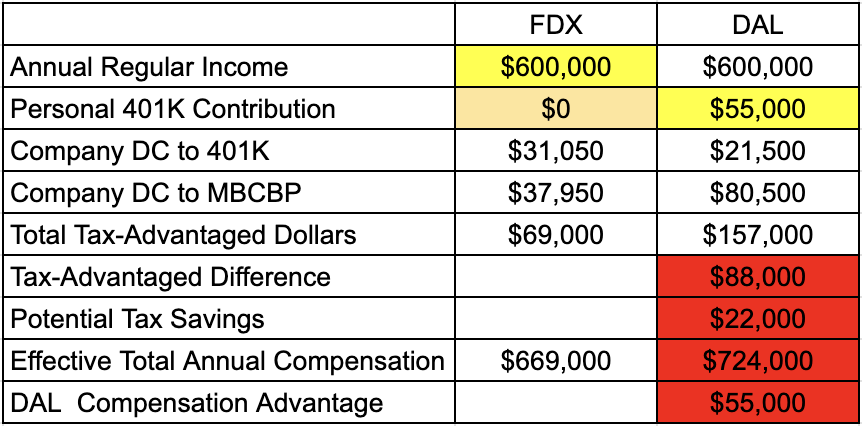
Finally, we’ll consider a more extreme case. Whether flying trips for premium pay, or flying as a Line Check Pilot with a top line pay rate of $483 per hour and an LCP override of an additional $144 per hour for a total rate of $627 per hour, $600,000 in annual income is reasonably attainable for a senior Delta pilot under their current contract. This is tougher for a FedEx pilot at current pay rates, though still possible. They’re likely to get pay increases on par with their industry peers, making this level of income equally attainable:

In this scenario, the Delta pilot’s ability to front-load personal contributions into their 401k maximizes money into their MBCBP for the year, and wins them a staggering $157,000 in tax-advantaged dollars.

By using Traditional (instead of Roth) contributions, this would save the pilot an extra $22,000 in taxes this year. Between that and their 17% DC continuing to pay out long after the 20% purple pay cut of our freight dawg, the Delta pilot enjoys an extra $55,000 in effective overall compensation this year.

Soft pay is critical in airline pilot contracts. In this case, two seemingly small provisions make a five-figure difference every year. First, the Delta pilot’s DC doesn’t cut off at an arbitrary and unnecessary point. Second, the fact that all excess money spills into a MBCBP allows the Delta pilot to maximize tax advantages by front-loading large personal contributions.

So What?

The intent of this project is not to disparage one contract, or even one failed Tentative Agreement. This is merely a mathematical examination of the implications of a given proposal.

Now that TA1 is ancient history, the FDX MEC will reach out to their pilots for input on what a future TA2 has to include for it to pass. The UPS union leaders are also likely seeking input from their pilots in preparation for negotiations that could start later this year.

I hope this case study illustrates the value of a couple key provisions in one contract that may be attainable in others thanks to Captain Dave Behncke’s grand strategy of pattern bargaining.

I suspect that these contracts will continue a trend of seeking to end the pensions at these companies, giving current pilots the option to transition to a MBCBP. Based on Part 1 of this series, and our comparison here, there may be more pilot support for this trend than traditional opinion might suggest.

Even just considering the IRS contribution limit of $69,000 per year, it will likely take fewer than 25 years for a 401k plan’s value to match or exceed the value of a legacy pension. If you really want to see some big numbers, use the FDX Case Study tab from this calculator to find out how much money you could put into tax-advantaged accounts if you include some personal contributions under contract rules like those at Delta. (It doesn’t take much to get that number above $90,000 per year). Then, use that number for your Annual Contribution amount on the Pension Calculator tab from Part 1 of this series.

(Spoiler alert: these numbers put any legacy pension to shame).

I strongly recommend discussing the implications of these calculations with a Certified Financial Advisor. If you do, they may help you frame the inputs you give your union reps on what kinds of provisions you want to see in your next contract.

I wish you all the best in those efforts. I’d be thrilled to walk an informational picketing line in your support, though I hope your management doesn’t let things get that far.

This post’s featured image came from Levi Meir Clancy on Unsplash.

Airline Pensions Part 1: Gold Standard or Money Left On the Table?

Which is better: a pension or a well-funded 401k account?

One of the reasons I started writing about Pilot Math is that I’m sick.

I’m sick of people making bad decisions and then saying it’s my job to fix their problems. I don’t mind people considering emotions in big decisions, but I’m sick of people making emotionally-driven decisions without giving sufficient weight to actual data. I’m writing about pensions today because I’m sick of hearing about lost pensions and how great they are (or were).

Yes, in the early 2000s a combination of bad laws, a market downturn, and some highly questionable corporate decisions led most airlines to abandon pilot pension plans they’d committed to funding in perpetuity. The airline’s part in this whole drama was irredeemably deplorable, and the pilots of that era deserved better.

However, those pension plans are gone and they aren’t coming back. The appearance of new Market Based Cash Balance Plans (MBCBPs) in the most recent wave of major airline contracts all but seals that deal.

Why even discuss pensions then? Recent events set up a case study that conveniently provides us with some real-world numbers for a head-to-head comparison. Yes, you’re getting another PMTB spreadsheet to play around with.

My Writing Prompt

The events in question started with the recently failed Tentative Agreement (TA1) at FedEx. This proposal attempted to address some shortcomings of their pension plan, gave current pilots the option of shifting to a different system, and would have excluded future pilots from the legacy pension plan altogether. I have no doubt their next TA will include similar provisions of some kind, meaning a few thousand of those pilots will likely have the option of sticking with or freeing themselves from their pension plan going forward. This will likely influence negotiations at UPS as their contract extension runs out in 2025.

I got some negative (and lots of positive) feedback when I weighed in on FDX TA1. I might not have written this at all until the FedEx ALPA MEC posted two new episodes to their podcast, Fly By Night. (Here’s Part 1, and Here’s Part 2.) A fantastic production, this podcast does a great job listing the strengths and weaknesses of DB pension plans, newer Defined Contribution (DC) plans like the 401k, and potential options like MBCBPs.

This article focuses on an academic discussion in hopes of helping end an industry-wide debate that should have died out long ago. I have friends at both brown and purple, and include some considerations in hopes of ensuring those union brothers and sisters have context for their upcoming negotiations. I do that somewhat selfishly hoping that any retirement reforms they gain might influence the MBCBP at my own airline during our next round of negotiations (as has already happened with United). If my writing about purple topics induces pain in your posterior, then you need to read this disclaimer, then move on to a different website.

Pension Valuation, Part 1

One of the big weaknesses of the current FedEX DB falls under what the podcast episode called a “contractual cap.” Although top pay rates at $335/hr mean senior FedEx captains likely earn well in excess of $335,000 per year, their pension calculations are all based on a maximum Final Average Earnings (FAE) of $260,000 per year. Maximum pension benefits (at 25 years of service) are 50% FAE, meaning the most a FedEx pilot can possibly get in retirement is $130,000 per year.

That’s a lot of beer money for not showing up at work anymore, but how much value does that actually represent?

Trinity University and the 4% Rule

In the late 1990s, some smart geeks at Trinity University investigated an interesting question: if a person retires at age 60 with a nest egg saved up, and lives for 30 more years, how much of their retirement savings can that person spend each year without running out of money before they die?

Commonly referred to as The Trinity Study in personal finance circles, this rigorous mathematical examination considered every 30-year period in the entire history of the stock market, running separate scenarios that both accounted for and ignored inflation. They considered a variety of withdrawal rates expressed as percentages of the original balance of the retirement account, to find out which ones would last for at least 30 years.

If you haven’t read this study yet, you should. The results changed my world forever, and my family enjoys a life of financial independence, free of monetary worries, as a result.

The Trinity Study concluded that in almost every 30-year period in the history of the stock market, a retiree could safely spend 4% of their portfolio’s initial value each year and not run out of money. This includes the worst case scenario we have…retiring the night before the Great Depression started. How’s that for peace of mind?

The Study also noted that 4% is extremely conservative in many cases. In many 30-year periods, much higher withdrawal rates still lasted the retiree until age 90.

As further evidence that the 4% rule is very conservative, the study also looked at how much money would be left in a given retiree’s account after 30 years. In the overwhelming majority of cases, spending levels at or well above 4% resulted in significant funds left over. In many cases using the 4% rule, the ending balance in the account was more than double where it started! I believe most pilots are safe to spend well above 4%, though you should definitely consult with a Certified Financial Planner before doing so.

If you want more reason to believe the 4% Rule is way too conservative, I strongly recommend listening to Episode 351 of the BiggerPockets Money podcast with Michael Kitces. He spells everything out very effectively.

A fantastic discussion on the risk profiles associated with the Trinity Study. It will lead you to question the necessity of the 4% Rule’s conservative stance, in a good way.

The financial independence community has latched on to the safe/conservative results from this study and refers to them as “The 4% Rule.” A pilot like you or me can use this rule to calculate how much money we need to save to achieve a desired retirement spending level (divide your desired annual spending by 4%, or 0.04), or it can tell you how much you’re allowed to spend each year based on the size of your nest egg (in this case, multiply the nest egg’s value by 0.04).

Although I think this is a great rule of thumb, there’s a strong case for saying it’s unnecessarily conservative. In many of the Trinity Study’s scenarios, spending rates upwards of 8-9% still succeeded much of the time.

It’s also unnecessarily simplistic to assume a retiree will spend the exact same amount of money each year, every year, no matter what. It’d be valid for a retiree to plan on adjusting annual spending in the 4-9% range, based on market performance, with the help of a CFP.

I’ve also demonstrated that the average American family can live a happy, comfortable life on far less than 4% of the nest egg that an average US airline pilot will accrue during their career. Unless you spend money like a fool, your airline pilot career should give you great peace in regards to personal finance.

Knowing this, let’s go back to our pension discussion.

Pension Valuation, Part 2 – Applying the 4% Rule

Having reviewed the 4% rule, let’s consider how much the FedEx pension is actually worth. The current FAE cap is $260,000, resulting in an annual payout of $130,000. Applying the 4% rule equates this to having a nest egg of $3,250,000 on the day a pilot retires.

We’ll also consider two other scenarios here. The failed TA1 offered current pilots the chance to switch to a MBCBP going forward. This would have frozen their current pension benefits and assigned a new, higher FAE cap of $290,000. TA1 also raised the cap for pilots sticking with the old DB plan to $338,000. These higher caps would have represented annual pension payouts of $145,000 and $169,000, respectively. Applying the 4% rule equates those payouts to nest eggs of $3,625,000 and $4,225,000 at retirement. Let’s present those in a table:

FAE CapAnnual Payout4% Rule Equivalent
Current Contract$260,000$130,000$3,250,000
TA1 MBCBP Opt-In$290,000$145,000$3,625,000
TA1 Cap Increase$338,000$169,000$4,225,000

At first glance, this seems like a lot of money. If you can’t live an amazing life on $130,000 in modern society, you’re doing something wrong…especially after a career where your earnings should have been more than enough to pay off your house, fund important family activities and events, and buy plenty of toys.

Yes, I am judging you…just like I know you’re judging me.

Increasing that benefit to $145K/yr or even $169K/yr just adds more icing on top of an already thoroughly-frosted cake.

In the 2000s, most airlines used bankruptcy to abandon their pension plans and started instead making direct contributions to individual pilot 401K plans. So, the next question we need to ask is: if a pilot’s 401K account hit the IRS maximum each year, could it ever be enough to replace that pension benefit?

For starters, we’re going to make a conservative assumption that a pilot only receives company contributions up to the IRS limit of $69,000 per year in their retirement accounts (401K and MBCBP). This is conservative enough to be absurd. This limit has increased by $1,000-$3,000 every year that I’ve been paying attention. It will most likely continue to increase in the future. I used $69,000 here because I felt lazy, but you can absolutely automate a 3-5% annual increase each year on your personal copy of our calculator.

The long-term return of the market is above 10.5%, but we’ll be conservative and leave some room for inflation by only assuming a long-term return of 5%. Investing that sum in a retirement account each year with those returns could potentially yield the following results:

YearAnnual ContributionCost BasisTotal Value
1$69,000$69,000$69,000
2$69,000$138,000$141,450
3$69,000$207,000$217,523
4$69,000$276,000$297,399
5$69,000$345,000$381,269
6$69,000$414,000$469,332
7$69,000$483,000$561,799
8$69,000$552,000$658,889
9$69,000$621,000$760,833
10$69,000$690,000$867,875
11$69,000$759,000$980,268
12$69,000$828,000$1,098,282
13$69,000$897,000$1,222,196
14$69,000$966,000$1,352,306
15$69,000$1,035,000$1,488,921
16$69,000$1,104,000$1,632,367
17$69,000$1,173,000$1,782,985
18$69,000$1,242,000$1,941,135
19$69,000$1,311,000$2,107,191
20$69,000$1,380,000$2,281,551
21$69,000$1,449,000$2,464,628
22$69,000$1,518,000$2,656,860
23$69,000$1,587,000$2,858,703
24$69,000$1,656,000$3,070,638
25$69,000$1,725,000$3,293,170
26$69,000$1,794,000$3,526,828
27$69,000$1,863,000$3,772,170
28$69,000$1,932,000$4,029,778
29$69,000$2,001,000$4,300,267
30$69,000$2,070,000$4,584,280
31$69,000$2,139,000$4,882,495
32$69,000$2,208,000$5,195,619
33$69,000$2,277,000$5,524,400
34$69,000$2,346,000$5,869,620
35$69,000$2,415,000$6,232,101
36$69,000$2,484,000$6,612,706
37$69,000$2,553,000$7,012,342
38$69,000$2,622,000$7,431,959
39$69,000$2,691,000$7,872,557
40$69,000$2,760,000$8,335,184
41$69,000$2,829,000$8,820,944
42$69,000$2,898,000$9,330,991

Note that a FedEx pilot doesn’t receive full pension benefits until reaching 25 years of total service. For our initial scenario, a pilot who invested themselves instead of relying on a pension would end up with $3,293,170 at 25 years. This is strikingly close to the $3.25M in total value we calculated by applying the 4% rule to the $130K annual payout under the current FedEx pension.

At a basic, perhaps overly-conservative level, this suggests that current IRS contribution limits provide a roughly equivalent replacement for a traditional pension. That makes sense to me.

This also says that if I had the choice between a pension and increased DC from my company, I might be safe choosing either.

Now, this doesn’t account for the fact that many airline pilots won’t reach 25 years of total service. Many retire early for medical reasons. Some have other things to do in life and just don’t stick around. Some started later in life. The pension only increases at 2.5% per year while we’re conservatively assuming that our investments grow at twice that rate. This suggests that anyone planning to retire with fewer than 25 years of service loses out with the pension.

It’s also critical to note that flying for longer than 25 years does nothing for a FedEx pilot. It will not increase their pension payout. A pilot hired at age 23 (and I fly with them regularly at my airline) will have a full 42 years to work at their airline. Financially, it would not make sense for that pilot, or any pilot starting at FedEx under the age of 40 to want the pension. They’d be leaving millions of dollars on the table.

One final way to view this data is that if you choose to work for more than 25 years, or if you let your personal retirement savings sit for more than 25 years before you dig into them, the 4% Rule will allow you to spend a higher dollar amount per year than what your peers will get with their pension after the same number of years at their company.

It’s starting to look like that pension isn’t such a great deal for a lot of pilots. Let’s not stop there though.

Pension Valuation, Part 3 – Beyond the 4% Rule

Remember how the Trinity Study showed the 4% rule to be extremely conservative? In many cases, a retiree can safely spend far more than 4% of their nest egg’s initial value each year without ever running out of money. It might not be reckless or unrealistic for a pilot to plan on spending 6%, 8% or even more of our nest egg each year in retirement without running out of money, especially if that pilot had other savings.

If we were to use a 6% or 8% rule, we’d need to re-calculate the value of the FedEx pension. Here’s what those numbers look like:

FAE CapAnnual Payout6% Rule Equivalent8% Rule Equivalent
Current Contract$260,000$130,000$2,166,667$1,625,000
TA1 MBCBP Opt-In$290,000$145,000$2,416,667$1,812,500
TA1 Cap Increase$338,000$169,000$2,816,667$2,112,500

These scenarios drastically change the value proposition of the FedEx pension.

Using a 6% rule, a FedEx pilot could potentially save up a nest egg equivalent in value to their pension after just 19 years of investing. An 8% rule puts this break-even point at 15 years.

Even under the maximum TA1 FAE cap of $338,000, a 6% rule would break even at 22 years, while an 8% rule would break even at 19 years.

This means that if a pilot wants to retire before 25 years of total service (or worries they may be forced to retire early) they’ll hit that target annual retirement income far more quickly by investing in a 401K/MBCBP than by relying on the pension.

These implications are even more important for pilots who plan to stick it out for the full 25 years. Why would you stick with a program that only pays the same $169,000 after 30 or 40 years of working that it also pays after 25 years of working, when you could save up that much on your own with just company DC in 19 years?

If you choose anything less ridiculously conservative than a 4% rule, or is you expect overall market returns above 5%, you’d be leaving a lot of money on the table by choosing to stay with the pension plan while working at FedEx for a full 25 years.

If this section didn’t rock your world, you need to go back and reread it until it does.

It’s very likely that a pilot would end up with far more money overall investing company contributions into their own 401k than they could ever hope to get from a legacy pension plan.

Case Study Conclusion

In my ever so humble opinion, I believe this should permanently conclude the discussion on whether 401k plans are better than legacy pension plans. These numbers include a lot of assumptions, but they’re fairly conservative overall.

I’d love for you to try running your own numbers though. Here’s a link to the spreadsheet I used for this case study. (You have to download your own copy. Don’t ask for permissions to edit mine.)

I’d also love for you to run numbers until you’re confident with them, then send your calculator to your Certified Financial Advisor as setup for a live discussion. If you do this, I think they’ll agree on the math.

As with all things related to aviation, there are plenty of “it depends” caveats here. First, different assumptions produce different results. That’s why you get to download your own calculator. There are also some other negative characteristics of pension plans that bear discussing here. The biggest problem with pensions is that they usually aren’t heritable.

For our purposes, money being “heritable” means your descendants get that money if you die. Although some legacy pension plans allow the spouse of a deceased pilot to continue receiving at least some benefits, that’s usually the end of the line. Once both spouses are gone, their kids get nothing.

That sucks.

Modern retirement accounts are the exact opposite. If your 401k has $1M the day you die, your kids can inherit $1M, and some or all of the tax advantages associated with that retirement account.

Remember: the Trinity Study showed that in most cases using The 4% Rule, a retiree’s account had more money in it at death (assumed at age 90) than it had when the reitree started withdrawing money at age 60!

If a 401k plan receiving $69,000 per year in contributions grows to exactly the same $3.2M in value after 25 years that a pension is worth, the 401k is vastly superior for anyone who wants to pass anything on to their heirs.

One final detail makes all the difference here for me. Part of the reason senior airline pilots lost their pension is that those plans are considered an asset of the parent company and subject to creditor claims in bankruptcy. Given the history of the airline industry, this would leave me terrified if I worked at a company that still offered a legacy pension. The most fundamentally important thing about a 401k account (and partially true about a MBCBP) is that the money in that account belongs to the individual. The company doesn’t control it, and creditors can’t go anywhere near it if your company declares bankruptcy.

Although many pension plans end up under-funded and in trouble, it appears that at least the FedEx pension plan is well-funded for the time being. That’s great…unless, God forbid, the worst were to happen and creditors got access to those funds. If a company were suddenly unable to cover their debts, and creditors started taking whatever they could get, an over-funded pension plan would be ripe for the picking.

Many pilots got screwed in airline bankruptcies of the early 2000s. Nothing will ever restore what is lost, and that’s wrong. However, for anyone going forward, a 401k plan offers at least as much money as a legacy pension plan, and potentially far more. Also, that money can be passed on to your children, unlike pension payments. Most importantly, that money can’t be taken from you in the event of a corporate bankruptcy. I cannot think of a reason that I’d advocate for a legacy pension plan over a 401k.

This concludes Part 1 of our pension discussion. Some details of the FDX retirement plans bear further discussion. If you care to read about them, check out Part 2. Otherwise, thanks for reading.

Thanks to Piret Ilver on Unsplash for this post’s feature image!

Second Career Pilots – December 2023 Update

A few years ago, before the COVID pandemic, I wrote a post on TPN for Second Career Pilots. While almost everything in that post remains relevant today, our industry experienced some titanic shifting over the last four years. It’s high time for an update.

My prompt for getting around to writing this happened when a friend, whom we’ll call Melvin, wrote with some questions. He holds a USAF navigator rating, but wants to work as an airline pilot after he retires in a few years. He’s finishing up his FAA pilot ratings and expects to hit ATP minimums within six months of retiring. After reading my recent post about Delta’s pay rates he asked: “Is Delta realistic for me with 1,501 flight hours at age 50?” He  assumed that if I answered “No” he’d be stuck at a regional airline for the next 15 years.

Bottom line: I believe a 50-year old pilot can enjoy a fun and lucrative second career at Delta or another major airline. Even if they don’t get to a major, the “worst case” alternatives are most likely not regional airlines. Today we’ll look at some big-picture industry forces, and consider how those might affect a second career pilot like Melvin.

COVID: Speed Bump + Knee Jerk

Our discussion about job prospects in 2023 and beyond has to start around March 2020. At its height, the COVID pandemic was very scary. It wrecked our economy for a while. However, it was largely an artificial and temporary curb on travel demand.

Global air travel demand in June 2023 surpassed 2019 levels. For reference: 2019 was about as busy as the US airline industry had ever been pre-COVID. Although we’ve returned to those levels overall, the demand for international travel with US carriers still has room to grow before it matches 2019 levels.

This means the airline industry is operating at Maximum Continuous Thrust, and could still be doing more. Delta Air Lines has been hiring more than 2000 pilots per year (more on that soon) and yet it’s so understaffed that it’s given out 8,000-14,000 duty periods of premium pay per month since the pandemic recovery began. Each of those duty periods represents at least 10.5 hours of extra pay for Delta pilots. Other airlines are in similar situations.

Put simply: the airlines are and continue to be unable to staff their operations to meet current demand, let alone staffing for growth.

It doesn’t help that circumstances looked particularly dire at the start of the pandemic. With no cure of vaccine in sight, and mass confusion about effective ways to prevent the spread of COVID, the airlines all found themselves desperate to stem massive losses. One popular measure was offering early retirement to the most senior (and expensive) pilots in the industry. A few thousand pilots took such deals just at American, Delta, and United.

That strategy was fine, until President Trump’s Operation Warp Speed helped create an effective vaccine and started a strong recovery sooner than anyone expected. (Odd, isn’t it, how many MAGA gobblers seem to have forgotten that Trump himself was a driving force behind the creation and distribution of the very experimental, and very effective COVID vaccine?) With COVID increasingly under control, and America’s patience thoroughly exhausted, travel demand spiked just as the airline industry found itself thousands of pilots short. It has yet to catch up.

Growth

Before the pandemic, most airlines were growing rapidly. Since the recovery started, those expansion plans have resumed and expanded. Consider the following:

Although some of these aircraft orders will replace aging jets, the majority are pure expansion. (And this list goes nowhere near describing the entire US airline industry). Delta plans to keep flying many of their B757s and B767-300ERs into the 2030s! Many of the retirements that were due already happened during the pandemic.

So, riddle me this: if travel demand already exceeds 2019 levels, and the airlines can’t staff themselves to adequately meet that demand with their current fleets, how can they possibly staff themselves to fly all of these additional aircraft?

If I was a second career pilot, I’d see significant opportunity here.

1,501 Hours

I hope we’ve just answered one part of Melvin’s question. The demand for pilots at major airlines is so insatiable, that even a late bloomer should be able to get to one.

Now, will the most desirable airlines hire a second career pilot at 1,501 hours total time?

The good pilot answer here is: “It depends.”

The obvious answer is: “Probably not.”

Most major airlines expect a pilot to get some professional turbine flying experience under Parts 121, 135, or 91K before applying. That said, as a NYC B737 Captain, I fly with the most junior pilots at my airline. I’ve flown with 23 year old aviators who have fewer than 2,500 hours total time. A couple airlines (American and Allegiant for sure) have been interviewing pilots and awarding them CJOs at hiring conferences for at least a year. United has hundreds of unfilled Captain seats available right now, and needs fresh blood to bolster seniority to help convince someone to step up. I would be shocked if every pilot in those dog and pony shows had more than 2,000 hours. There is a very real chance that a pilot like Melvin could get hired by a major airline as soon as he reaches unrestricted ATP minimums.

Most pilots, second career or otherwise, will need to do something like the old Regional Airline Touch & Go. The thing is, pilots don’t even need to do that Touch & Go at a regional airline anymore. Remember how the Tier 2 airlines like Frontier, Spirit, and others are also trying to grow like crazy. They’re rapidly losing pilots to the majors and have no choice but to hire the most inexperienced aviators in the industry. Even Southwest has suffered from what one article calls “resume washing.”

So, if any low-time pilots, including older ones like Melvin, need to fly for a starter company before moving on to the majors, it doesn’t need to be a regional airline. At the very least, it should be a Tier 2 carrier flying Boeing or Airbus products. (Apparently, this could even include Southwest even though I tend to include them on my list of 6 major airlines.) This is awesome! It means better pay and work rules while building your hours. It means you’ll accrue hours more quickly than if you’re doing 15-minute hops between places like Detroid and Flint.

Part of the reason Melvin asked if he’d have to fly for a regional before a major is that he’s worried about getting stuck there. I don’t blame him. The regionals have some truly terrible work rules. Eventually, they’ll stop paying as much money too. I feel bad for any pilot who gets stuck at one through no fault of their own.

Thankfully, most of the Tier 2 carriers are places where most of us would be lucky to get stuck. They pay well, and have much better work rules than the regionals. They fly to some interesting places. With all the movement going on, seniority progression should be fairly continuous. If I were in Melvin’s shoes, I wouldn’t even apply to a regional until I’d explored all these options.

And yet, I think there’s still some time to stop by one of these carriers and still get hired by a major. Starting at a Tier 2 airline at 1,500 hours, it shouldn’t take an industrious pilot more than 18-24 months to hit 2,500 total hours. We’ll discuss this more in a moment, but if a second career pilot can’t get hired by a major at 2,000-2,500 hours in this environment, they’re doing something wrong.

Cycles and Waves

Although I’m optimistic for aviators like Melvin, that doesn’t mean they shouldn’t hurry! This hiring boom isn’t endless. The wave will eventually peak.

After that peak, the industry should still enjoy a hiring steady state higher than it was in the early- to mid-2000s. I have zero faith in the military’s ability to improve pilot retention, which should help all-civilian pilots, and second career aviators like Melvin. However, competition will get tighter. The majors will be the first places to get healthy, and career progression there will slow significantly.

If your ultimate goal is a seat at a major airline, there is no excuse for putting anything less than maximum effort into getting there ASAP. If there’s any way to follow a version of the Ideal Military Pilot Career Path and finish out your time in the Guard or Reserves while focusing full-time on flying, you should!

I’m confident any non-rated military member can find part-time staff work as a TR or IMA. Do that for a few years while you finish your hours and ratings, then do your initial Touch & Go at a regional or Tier 2 carrier, then move on to your major ASAP. Once you’re on that seniority list, take 3-5 years of AGR orders and finish up that way.

DE&I

Although I believe we’ve answered most of Melvin’s questions, there’s one subtlety he didn’t even necessarily want to spell out. He didn’t ask: “Will they even hire an older pilot, knowing they can’t get as many years out of me?”

The short answer is: “Yes, they will.”

For some anecdotal support:

  1. The Delta ALPA MEC publishes some basic demographic data on each hiring class. I know that Delta has recently hired pilots as old as 61.
  2. In the last year, I flew a trip with a new-hire FO in his mid-fifties.
  3. I know plenty of airline pilots who retired after reaching O-6, or higher. This took them more than 20 years on active duty, meaning they were in their late 40s or early 50s when they started at the airlines. Yes, they had past flying experience, but that doesn’t make as much difference as you think. (More on that shortly).

Let’s use this question as an opportunity to discuss a bigger (positive) trend in our industry.

Every serious airline these days places great emphasis on the ideals of Diversity, Equity, and Inclusion (DE&I).

This is good.

While DE&I certainly covers categorizations like race and gender, it goes far beyond that. Intelligent business people value diversity of backgrounds and ideas. Most have done away with hiring quotas from affirmative action days, which is good because those gave the impression (or reality) of hiring less-qualified people for the sake of meeting a quota. Instead, most DE&I efforts these days focus on reaching out to increase a company’s pool of qualified applicants.

Since most pilots in the US are middle-aged white dudes, this means that particular group faces more competition for jobs in these pools. That’s not a bad thing. If you want the most qualified people to get the job, then you shouldn’t mind greater numbers of qualified people being in the pool. If this makes you less competitive it’s your own damn fault. Go make yourself better and apply again.

An important part of that process means lawyers watch airline hiring departments like hawks. They’re extremely careful to avoid even the appearance of bias or prejudice. They insist that hiring departments give every applicant the same shot at a job, regardless of any DE&I categories. This is awesome!

If you meet an airline’s requirements for ratings, flight hours, medical certificate, etc. you will get the same fair shot at the job as anyone else there that day. Period. At that point, thanks to the unrelenting scrutiny of the “blood-sucking lawyers,” DE&I categories have no influence on a candidate’s chances.

The category that concerns Melvin is age. I can say with absolute certainty that no worthwhile airline will forgo hiring an otherwise qualified applicant right now because of that pilot’s age. If some airline out there wants to prove me wrong, then they’re a shitty company. They deserve to be sued out of existence by denied applicants, and I wouldn’t want to work there anyway. Thankfully, I believe all major US airlines and most others are firmly committed to doing the right thing here. Older pilots like Melvin have nothing to worry about.

Make Yourself Competitive

I can’t emphasize enough that, although I think second career pilots like Melvin can get to the major airlines, they need to work hard to make this happen ASAP.

I’ve always said that each pilot has to make their own stars align. That’s true here. Second career pilots must take action to make themselves competitive.

This means pouring money and free time into getting hours and ratings now. If you’re already in a career, you probably have some resources for making this happen. If not, I wrote a 6-part series on helping to obtain funding. Also, veterans charity RTAG has mastered the art of squeezing every penny out of the government gravy train. If a military member needs help funding flight training, RTAG can help them.

This also means no cutting corners on your ratings. Young pilots sometimes forego things like a Commercial Single Engine rating, or flight instructor ratings altogether. That’s gonna be a nah for you, dawg. You need to earn Commercial ASMEL, along with CFI, CFII, and MEI ratings on your way to an unrestricted ATP. Yes, this will mean some training courses that are more expensive than just smashing bugs in a rented C-152. That’s okay because it makes your application more competitive.

Since you’re trying to make yourself stand out anyway, I recommend you also ensure you get endorsements for tailwheel, complex, high performance, high altitude, etc. I suggest you pursue glider and seaplane ratings. Not only are they eye-catching on an application, they’re a whole lot more fun than that corrosion-infested C-152.

You should try to find some paid flying to help get you from 250 hours to 1500. Look for jump operations, glider towing, survey flying, and small charter operators. You need to start showing career progression as a pilot. Any time you can step up as a chief instructor, chief pilot, or otherwise demonstrate aviation leadership is good.

Some pilots seem to think of their non-pilot background as a weakness. That shouldn’t be the case. I would expect that in your first career you experienced career progression and gained leadership and other skills that any airline will value. Don’t be afraid to continue pursuing advancement if you have more time left in your first career before you shift to full-time aviation.

Put yourself in your future hiring board’s shoes. What would interest you more? The 23 year old who had rushed so hard to get ratings and hours that they didn’t even bother with college and has never held a job other than stick monkey…or a mature adult with a BS, MS, or even PhD and years of practice at being responsible and leading others?

You already look pretty good to an airline. The next thing you have to do is just get the flying side of your resume to the point where it’s at least as good as that 23 year old. This means accruing as many jet hours as possible as quickly as possible.

This is incredibly difficult to do flying between ATL and CSG six times a day without ever climbing above 18,000 ft. It’s a lot easier to do flying an Airbus or Boeing product on transcons, Florida turns, and Caribbean overnights. That alone is the primary reason why you should try to get hired at a Tier 2 carrier before you even consider a regional.

It’s also important to prioritize flying over other job activities. This is not the season of your life to be a squadron commander or project leader. This is not the time to diversify your aviation-related resume at a starter airline.

One second-career pilot friend of mine spent several years in the Army infantry before heading to a regional. When he arrived, they were thrilled to have a mature pilot with experience leading impressionable young men and women. They begged him to join their mentor program and quickly promoted him to a trainer/leader in that department, even though he was a low-time FO. He got paid well and enjoyed good QOL while spending a week a month, or more, training future mentors at Airline X’s HQ.

While this guy did a service to the industry overall, he paid for it dearly. All those weeks riding a desk were weeks he wasn’t accumulating flight hours. This delayed him upgrading to Captain, and left him stuck at the regional when the COVID downturn locked our entire industry in place for 18-24 months. Then, a military deployment popped up and instead of asking to go the next time, he took one for the team right as he might have been competitive for hiring at the majors.

Thankfully, he got hired at one of the less-desirable majors and spent a year there before the best major hired him. He has a training date in about a month. However, he likely lost 1-2 years of seniority at his forever airline…and that also means 1-2 years at top-line pay rates on that company’s biggest widebody.

If you gain fulfillment from non-flying jobs, you will absolutely find desirable opportunities in our industry. However, until you’ve at least earned an unrestricted ATP and 2,000 total flight hours, those things are only a waste of your time. Also, remember that if you’re not at your forever airline any big-picture work you do in the company is only going to strengthen a future competitor. Don’t do that to your future self. Save making a difference for when that influence will improve your forever airline. Wait until you get there, then start asking around. I promise, your managers will be thrilled to get some skilled and enthusiastic help.

Wrap-Up

The aviation industry is on a tear, and we haven’t even fully recovered from the COVID dip yet. The airlines don’t have enough pilots to cover current demand, and most have big expansion plans. If you want an enjoyable, lucrative job at a good company, it lies within your grasp no matter your age or background.

Deserved optimism aside, we must admit that our industry is cyclical. Eventually, things will slow from today’s breakneck pace. As such, anyone aspiring to fly for a major airline should get to work on making themselves competitive. Get your ratings and your hours. Don’t waste time building up a corporation or airline where you don’t plan to be forever. Don’t give up airline years to active duty military service if you could potentially finish your time in the Guard or Reserves after you have a seniority number at your forever airline.

Don’t forget that it’s up to you to make your own stars align. Work hard to make yourself competitive and your chances of achieving your goal will be high.

Older pilots like my friend Melvin can rest easy that they won’t face age-related discrimination. The airlines all need you badly enough that they’ll take whatever time they can get with you. Give them every reason to start that relationship sooner, rather than later.

Good luck in your pursuits. Reach out if you have questions. I look forward to making sure you couldn’t possibly pay for a beer as a new hire FO!

So You Make as Much as a Delta Captain, Do You?

I think we pilots tell ourselves a lot of lies. I’m shocked at how often I hear the following from regional or ULCC pilots: “I’m not even going to bother applying at a major airline. I make as much as a Delta Captain now!”

To be fair, it’s definitely possible to accomplish this at other airlines. However, I believe that Delta pilots can earn great money for less days away from home, while enjoying better work rules and Quality of Life (QOL).

As pilots, we all live according to my father’s wise words: “We’re all entitled to our own opinions, even if yours is wrong.” My personal opinion isn’t necessarily any more valuable to you than yours is to me. As such, I’ve created a spreadsheet to provide some hard numbers for your consideration. Math doesn’t care about what either of us thinks.

You can get a copy of the spreadsheet here. Please, use “File -> Download” or “File -> Make a Copy” to get your own personal version to edit. Please don’t ask for permissions to edit the master copy. Nobody wants to watch your gonkulations in real time.

What Are We Calculating?

This calculator has Delta’s pay tables built in (including the pay raises for 2024-2026). You select or input the cells in yellow, and the calculator tells you how much a Delta pilot makes given those assumptions.

Note: profit sharing may not be a thing at your company, but it’s a big deal at Delta. They’re on track to post profits above the $5B mark, and that could trigger profit sharing at or above 10%. You should run scenarios with and without profit sharing.

The second section is for a related post I wrote helping Delta pilots decide when/whether to upgrade. I recommend leaving it alone so you can see what things would look like if you were a Delta FO. Or, put “1” in the light yellow cell for “Years at Airline” to see what your new hire situation might be at Delta.

The third section is where you put your current information. The cells for Aircraft, Seat, and Years at Airline don’t matter because I don’t have any formulas set up to use them. (You’re welcome to input your pay tables on new tabs, copy my code, and make your version of this calculator even fancier!)

What matters is that you set realistic values for Profit Sharing, your company’s 401K contribution, your Average Daily Guarantee (ADG, or the number of hours of pay you normally credit per day of work), and your hourly pay rate.

Once you have those numbers input, the calculator assumes you want to make as much per year as a Delta Captain and works backwards. It factors out your company’s 401K contributions and profit sharing, and determines how much money you’d have to earn each month to reach that goal. Then, using the hourly pay rate and ADG you gave it, the calculator show how many hours of credit you’ll have to earn each month. Assuming you fly the ADG number you input, it also shows how many days per month you have to work to match your Delta peers.

Let’s try some examples. I’m pulling my information from the always excellent AirlinePilotCentral.com. If my numbers are off, I apologize. Please use your superior data to get answers that are accurate and useful for you.

Spirit vs Delta

I have a couple friends at Spirit right now. When I wrote to congratulate one and ask whether he’d already submitted his Delta app, he said, “No way dude! Spirit’s way better and I make as much as a Delta Captain anyway.” He must be working a lot…especially a lot more than I am.

Let’s start with something outlandish and assume he was able to upgrade to Captain at Spirit in his first year (APC puts the junior Captain as a 2019 hire) and that he gets Year 12 pay in year one and only ever flies the A321at $306/hr. Spirit isn’t known for their profit sharing, and they lost money this quarter, so we’ll assume zero profit sharing for them.

We’ll compare to a Year 1 Captain at Delta (very common right now) flying the A321ceo, and assume 0% profit sharing (unlikely this year.)

Here’s how things stack up:

Although this situation is quite unrealistic, the disparity isn’t that great. It shows that the most senior Captains at Spirit only have to work 83 hours to equal what a Year 1 Delta Captain makes in 74 hours, by spending an extra 4 days per month at work.

For a more realistic comparison, let’s consider the case of my direct peers at Spirit. That means Year 8 pay with me on the B737-900ER and them on the A321. I’ll probably get 10% or higher profit sharing in 2024 and they probably won’t, but we’ll assume zero for both of us. I tend to credit an average of more than 85 hours per month through our contract’s wonderful soft pay provisions and by picking up the occasional premium trip. My trips tend toward efficiency, so I block at least 6.25 hours per day spent at work, on average. Here’s how we balance out:

It appears that my peers have to credit 23 more hours than me per month, spending as many as 10 more days at work per month than I do. Including 10% profit sharing for me widens that gap by another 10 hours of credit and another two days of work.

While premium pay would help close that gap in fewer days, this is a lot of extra work and a lot of extra days on the road just to break even. Spirit definitely has some advantageous work rules in some areas. However, I feel like the contracts at Delta and United beat Spirit’s contract overall. I feel like there’d have to be some pretty compelling and unique contract language at Spirit to make up for this difference.

Delta vs. Allegiant

Allegiant offers some compelling reasons to forego employment at a major airline. Almost all of their flying is one-day out-and-back trips. They have pilot bases at some truly amazing locations like Allentown/Bethlehem, PA, Asheville, NC, and others. Living in Tampa, I could work for them and drive to the St. Petersburg, FL, airport for work every day instead of commuting to NYC. They also have a base at Fort Walton Beach/Eglin AFB, FL, which would be vastly superior to commuting anywhere from what may be the densest population of retired military aviators on the planet.

Allegiant also has small pilot groups at each base. Assuming those pilots are all pleasant to work with, it would be fantastic to enjoy a tight-knit relationship at your base.

That said, these pilots give up a lot when it comes to pay. APC shows Allegiant’s top line Captain pay at $230 per hour. Compared to most other US Airbus operators, that figure is abysmal. APC also shows that Allegiant only matches 401K contributions up to a maximum of 10%. That’s far below the industry average. Let’s see how this stacks up against a Delta Captain flying an Airbus with the same number of years of service:

The Delta pilot works 74 hours per month and makes $372K. The Allegiant Captain who has flown the exact same aircraft for the same number of years would have to credit 122 hours, which could take nearly 26 days per work at minimum guarantee. APC says that Allegiant pays 130% for everything over 81 hours, which is a calculation beyond the scope of my spreadsheet. Still, this means nearly twice as many days at work for the same amount of money.

We can adjust our calculator to consider a move to Delta by setting the DAL Captain hours at 45 per month. This yields a reasonable 74.7 hours per month for a current Allegiant Captain and puts annual income around $227K.

If that Captain moved to Delta, they’d need to credit 139 hours per month as an A320 FO to make what they were getting at Allegiant. If you read yesterday’s post, you’ll see that’s actually pretty doable. It’s also worth noting that second year pay at Delta is a 50%+ increase, and Captain upgrade is available in less than a year at Delta if a transferring Captain needed to restore their income quickly.

Money absolutely is not everything. If a pilot has been at Allegiant for 12+ years, they probably have their reasons all figured out. However, if you want or need finances to be a significant part of your career decision calculus, there’s no comparison between these two companies.

One side note here is that there’s a viable alternative to the kind of home basing offered at Allegiant (and maybe soon at Frontier.) When I flew the A220 the first leg of almost every trip NYC to either IAH or DFW. I did more layovers in those two cities during my time as an A220 pilot than I’ve laid over in any other location in my entire career.

I once flew a trip with an FO who lived in Houston. He was looking forward to going home on two of our three layovers that trip. I asked whether he’d applied for United and Southwest to be based at home. He said, “Hell no! Think about it. We’re NYC based, but when we leave NYC we usually don’t get back there until the end of our trips. I’m senior enough on this jet to get a Houston layover every trip I fly. This trip has two. If I worked at one of those companies, I’d never get another Houston layover again.”

I think this is a great counterpoint to the industry adage that all commuting is bad. Most of Allegiant’s bases are locations where a relatively junior Delta pilot could reliably bid for layovers on every trip. If you want time at home, you can get it even if you aren’t based at home. It’s worth running the numbers to consider what that would look like.

Delta vs. PSA

I understand when I hear about pilots not moving from companies with unique selling points.

  • It’d be tough to be living in Hawaii and flying for Hawiian (until the new Alaska merger forces you into an Anchorage commute, but I digress…). 
  • A U-28 reservist flying for Allegiant out of KVPS is a match made in heaven. 
  • A friend of mine fell in love with Fairbanks during Red Flag Alaska one year. He moved up there, joined the KC-135 unit, bought a C-170 on floats, and has been flying the Whale for Atlas ever since. There’s no reason for him to go anywhere else.

One of the few arguments I simply cannot stand to hear is when regional airline pilots assert that they don’t see the value in moving up to a major.

On one hand, I get it: if you’ve been at a regional forever, you probably have great seniority. You have your company, your contract, and your schedule figured out. You might be a Line Check Airman, meaning you’ve recently enjoyed pay rates as high as $427 per hour. You may live in base, with the ability to pick up trips at leisure.

And yet, I have only ever heard of a couple regional airline contract provisions that seemed palatable to me. Almost every other provision my FOs tell me about sounds egregious. Regional pilots get treated poorly.

Regional flying tends to be a lot of work too. Sure, the most senior pilots may be able to score the longest legs at the company, flying Magnolia Maniacs from NYC to Waco, TX, and back for 6-7 hours of pay every day. Most regional pilots are grinding it out with numerous short legs, never enough fuel, and suffering the lowest priority of any aircraft in the system.

There’s also so much turnover at the regionals right now that things are getting desperate. PSA even convinced FedEx management to try and push their B777 pilots down to the regionals. The memeatic derision for that one was as hilariously brutal as this proposal was…tone deaf.

Let’s run the calculator. The PSA senior pilot won’t want to be an FO again, so our first scenario assumes they stoop as low as possible at Delta and take a B717 Captain seat. Note that the PSA pay charts top out at 19+ years of service, and ADG at most regionals is closer to 4 hours than 5.25.

The hourly pay rates alone tell us a lot: $296 at Delta vs. $217 at PSA. It looks like our senior regional Captain has to credit at least 110 hours every month to equal the income of a first-year B717 Captain at Delta. At regular pay, this would mean working almost every day of the month at the regionals, though premium pay options would decrease that number somewhat. If you assume a Year 1 upgrade on the B737 or A321ceo, the difference widens by an additional 15 hours.

Let’s assume two PSA Captains read this now and one goes to Delta immediately while the other decides to wait 3 years to apply to Delta. By the time PSA Captain #2 leaves, the differences in their situations are impressive:

A Year 3 B737 Captain at Delta will have no problem crediting at least 85 hours per month. At 2026 pay rates, they’ll be up to $363 per hour while the PSA pilots will be at the same $217. In order to match their Delta peer, the PSA stalwart would have to credit 154 hours per month. Even with premium pay, that’s a lot of extra work.

Again, I don’t mind a pilot sticking at a regional if they have a lot of compelling reasons to do so. However, if money is a priority, or you want money plus time at home, there is no excuse for staying at a regional.

Takeaways

What does all this mean?

When you hear someone say, “I make as much as a Delta Captain,” at best they aren’t telling you the whole story. At worst, they’re lying to themselves.

In order to make as much as a Delta Captain anywhere else, you’re either spending a lot more days at work or you have a great system for earning premium pay. The latter is awesome, but the former is not.

Major airlines (Delta, United, American, Southwest, FedEx, and UPS) aren’t the right fit for everyone. Location, work rules, and general Quality of Life are critical factors in deciding where to work. However, don’t sell yourself short by not applying for a major just because you’re comfortable. Don’t settle.

I assert that you can make the same or better money at a major, for fewer days at work, than possible at almost any other company. With some potential exceptions, the work rules at these companies are vastly superior to what you get at a lot of Tier 2 or regional carriers.

Again, I don’t say this to brag or rub it in your face. The majors are all hiring and every Part 121 pilot in the United States is competitive at every single one. If you have significant reasons for staying at your current company, more power to you! However, if you’ve been lying to yourself, I hope this data helps tip the scales and convinces you to at least update your apps.

Thanks for reading. I hope this calculator helps. Remember: don’t ask for permissions to edit the master. I won’t let you have them. Use “File -> Download” or “File -> Make a Copy” to get a version you can edit.

Upgrade to Captain or Stay an FO? – Another PMTB Calculator

Should I upgrade to Captain, or remain an FO?

This is a common discussion topic on my flight deck because pilots at my airline can hold B757/B767 (“7ER”) Captain at or below one year on property. Upgrading on one of our narrowbody categories becomes possible just a few months after indoc. This isn’t unique to us. United has had several hundred unfilled Captain’s seats, just waiting for someone to take them.

The only viable answer to this question is: “It depends.” Too many variables make for rather complex calculus when facing this decision. There’s a lot to be said for the Quality of Life that comes with a good schedule every month, priority when dropping or picking up trips, being able to hold desirable vacation weeks, and more.

However, I also encounter a lot of FOs who are making as much money as I am, or potentially even more, by focusing on getting trips that offer premium pay. Why would I upgrade, they ask, giving up seniority and other QOL factors, when I’m earning as much as you are.

Yes, it is realistic to make as much as or more than a Captain as an FO. The question is: how hard does an FO have to work to reach that level?

This is Pilot Math Treasure Bath, so we’re going to use some real-world numbers to get some firm answers. You may know by now that I’m a fan of spreadsheets, and it shouldn’t surprise you that I built a calculator to address this specific question.

Captain vs FO Calculator

First off: this calculator is available to you for free here. Please use “File -> Make a Copy” or “File -> Download” to get a version you can edit. Please, DO NOT ask to edit the master. The rest of the internet has no interest in watching you gonk through your personal scenarios.

The calculator for today’s exercise compares Captain vs FO pay at Delta. I hand-jammed the pay charts for 2024-2026, including the raise Delta pilots got thanks to the United pilots triggering their “me too” clause. (I occasionally have fat fingers. If I made an error please just fix it on your copy. You can let me know if you like.)

Setting your inputs in the yellow boxes will project a Captain’s annual pay. By default, the calculator assumes you want to compare that income to FO pay on the same aircraft at the same year of service. (You can look at other scenarios by changing inputs in the light yellow boxes in the FO section.)

The calculator then assumes you want to make the same amount of money as an FO and starts working backwards from that value. It factors out company 401K contributions and profit sharing, then figures out how many hours of pay you’d need to earn per month to reach your annual total.

By default, the calculator assumes you only get the Average Daily Guarantee (ADG) of 5+15 hours of pay per workday. My category, the B737, usually runs more like 6-6.5 hours per day on average, so change that as appropriate for your category.

Your big takeaway will appear in the purple boxes. The number of hours required at a given pay rate and number of workdays required per month to get those hours appear next to each other on their respective rows.

Since Captain pay rates are higher, this calculation should show FOs needing more hours to break even. In many cases, this is doable without working too many extra days. Last summer, I flew with an FO who was on his 7th Green Slip (premium pay trip), in addition to flying an Inverse Assignment trip and getting a high-paying reroute that month (also sources of extra pay). When done correctly, a pilot could do this without working much more than I normally do. However, it’s important that you be honest with yourself. Premium pay isn’t always available when you want it.

Scenario #1 – Year 3 CA vs FO

Our first scenario considers a Captain on Year 3 pay flying with an FO from their new hire class. They’re essentially equal seniority, but the Captain only flies a guaranteed 74 hours per month. Here’s what we get:

Our Captain would expect more than $374K in total compensation, putting them in the top 2% of all Americans. Wow!

Could our FO match this? Absolutely! They would only have to credit an average of 121.6 hours per month. That’s 65% more hours for the same amount of money. Assuming only normal pay rates and flying the same number of hours per day, the FO in this example would have to spend nearly twice as many days away from home to match the pay of their Captain. Yuck!

Realistically, most of the difference here could be covered by the FO picking up a single 4-day Green Slip each month. In some categories, that’s a very reliable expectation. In others, this isn’t particularly realistic.

I chose Year 3 pay for this scenario because pay scales have a steep slope for the first two years. It doesn’t take too much for the FO to break even with the Captain. Let’s see what this would have looked like if these had been first year pilots:

Scenario #2 – First Year Pilots

Here we have a CA and FO flying the A320 on Year 1 pay:

The difference here is staggering. In order to make as much as a peer Captain, this FO would have to credit 210 hours…280% as much! This is equivalent to more than 51 days at straight pay, meaning this is physically impossible unless the FO has access to a lot of premium pay.


For me, this shows a significant financial advantage to upgrading early. If you’re going to upgrade early anyway, it’s worth the most in your first couple years.

Scenario #3 – Lazy Captain

Let’s switch gears for a moment and consider a different reason for upgrading. One of the arguments my FOs use for not upgrading is that they like their QOL. I think that’s a great choice, from a certain point of view.

However, I often wonder how little I could work and still make the same amount of money as the average FO. If you iterate through some scenarios on our calculator, you might come up with something like this:

I chose the B737 at Year 5 pay, and used a low estimate of the profit sharing that Delta pilots will most likely get in February 2024, just to make things different. You’ll find a similar break-even point using any consistent set of criteria.

Under these assumptions, a Year 5 FO who upgraded to Captain could cut down to only working 9 days per month, half of what they were doing as an FO, and make the same money. That’s one 4-day, one 3-day, and one 2-day trip per month…pretty light duty! As an FO, this pilot would have to fly four 4-day trips and a 3-day each month to make the same money. That’s a lot more time spent at work to have a little more control over your schedule.

This scenario assumes that, as a Captain, our FO would be able to drop a trip or two each month. The staffing vs scheduled flying at Delta is so out of control right now, that this is very unrealistic. However, we hope for a steady state where this becomes more of an option, if desired.

Scenario #4 – Back to FO

I once flew a B717 trip with a Captain who was about to go back to the B777 as an FO…the category he’d just come from. I was surprised. I knew that’s completely different flying, but what about the financial hit? It turns out it’s not nearly as bad as I thought.

At Delta, it turns out the top-line pay rate for widebody FO is only $13.02 per hour less than the top-line pay rate for B717 Captain. Using the 1000x rule of thumb, we’d normally assume this means the B717 Captain would make $13,000 more per year than the widebody FO.

Our calculator shows that this pilot would only have to work an extra 3 hours per month as a widebody FO to equal the pay they were making as a B717 Captain. This math is somewhat unique for the B717 because its pay rates are rock bottom at Delta. Anyone who can hold this seat can also hold Captain on an A321neo or B757. This significantly alters the math:

When comparing widebody FO to B757 or A321neo Captain, this FO would have to scrounge up a full extra week of work to break even. That’s a 50% increase, and there isn’t always that much extra flying available on widebodies, even if you want it. However, for one Captain I flew with, this switch made a lot of sense.

Scenario #5 – New Hires Working Too Hard

This calculator enables me to make clear a point that I sometimes have difficulty communicating to my FOs. I’m based in NYC where staffing is never great and opportunities to pick up extra flying from Open Time (typically) abound. I frequently encounter new hires so excited about Delta’s starting pay rates that they chase money hard throughout their first year.

Like Mr. Seven-Greenslips-And-Counting from earlier, several of my new-hire FOs have been flying like crazy, picking up a lot of extra flying out of Open Time. They seem to enjoy it while I’m happy to fly with them and proud to keep them hydrated on our layovers. However, I feel like this isn’t particularly efficient on first year pay. Let’s examine:

Delta’s first year pay is good, but it’s no better than regional airline pay right now. In order to earn as much as I am, my new-hire FOs would have to credit an average of 223 hours per month. While this is actually doable in some months, it’s not consistently an option. More importantly: a pilot flying that much puts themselves in danger of burnout way too early in the major airline portion of their career.

Starting at a new airline is a time of change, with excitement and challenges for pilots and their families. Yes, pilots moving from regional airline Captain to major airline FO are taking a pay cut these days. However, it’s worth relaxing a little and giving your family time to get used to this new phase of life. I don’t feel like it’s worth spending all your time on the road when your hourly pay rate is so low.

If you’re after money, wait until Year 2 or 3 when your hourly rate nearly doubles. Or, take that early Captain upgrade. Then, you can make more money working an average schedule than a hard-charging FO rushing toward burnout.

For comparison, consider this:

Even a Year 1 Captain can make as much money with just 26 hours of work per month as a Year 1 FO working a regular schedule. At Delta, there’s a scheduling option called a Monthly Blank Line (MBL). This awards the pilot 25 hours of pay for the month, with zero obligation to do any work. The company doesn’t award many MBLs, so it’s not realistic to expect to get one in any given month. However, in principle, a Year 1 Captain on an MBL would make as much as any peers working a regular schedule.

I say: fly your assigned schedule during your first year, but then enjoy spending time with your family. You will find more effective ways to chase money later.

Year 1 pay at a major airline is fantastic. It puts you in the top 13% of all Americans. If that feels like a drastic hit to your “lifestyle,” it means you’re doing everything wrong.

Yes, I am judging you.

Try rethinking your Pilot Math so you don’t end up poor and angry at the end of your career. A Year 1 major airline pilot should be making so much money that they can cover an average family’s needs and still sock away tens of thousands of dollars into savings. I know a self-published schmuck who wrote an entire book aimed at helping you figure that all out. I recommend waiting to get the 2nd edition, due out in 2024.

Scenario #6 – Captain Now vs. Career FO

Our final scenario for today is one I’ve considered many times. I also enjoy amicable arguments about this scenario with a few friends who remain zealously on the opposite side.

I’m a Year 8 B737 Captain. My friends are Year 10 A330 FOs. Thanks to the wonderful soft pay provisions in our new contract, my trips are very efficient and I don’t have to try hard at all to earn more credit than the minimum guarantee each month. Part of being efficient means my trips tend to credit an average of at least 6+15 per day, including soft pay. You’ll see those two facts reflected by me putting 85 as my “Monthly Pay Hours” and “6.25” under ADG in this run:

On the surface, this makes it appear that my widebody friends have to work upwards of 24 days per month, and credit 97.7 hours, to equal what I’m pulling down through 14 days of work per month as a narrowbody Captain.

If they actually had to work that many days, it’d be terrible. Realistically, they seem capable of picking up an occasional Green Slip, or flying trips with legs long enough to be much more efficient and reduce total days spent at work.

Even better, as Year 10 FOs, they’re senior enough to hold reserve. Yes, reserve goes senior on widebody categories because pilots tend to drop out less at the last minute. Reserve widebody pilots get used less than those on narrowbody categories, and I know of people who work an average of about 5 days per month, while still earning reserve guarantee.

It’s interesting to know that without any shenanigans, I’m making more money than senior peers without feeling that I have to work hard at all. However, It’s also a constant reminder of the fact that I could be making nearly as much as I am now (a stupidly large amount) while dozing for dollars on international flights to Europe.

It also makes me glad that I’m not stuck flying the worst narrowbody in the industry (or the Airbus) for the rest of my career like some friends at other airlines.

Conclusion

I hope you enjoy playing with this calculator. I hope it’s useful in helping you strategize future AE bids. My goal here is not to convince you to upgrade. Staying senior as an FO has many non-monetary advantages. If I were to do it, the goal would be to spend even more time at home than I do now. In my opinion, the QOL-based reasons for not upgrading are morally and ideologically superior to chasing money. However, if when discussing your career decisions and plans you use money as justification for not upgrading, this may weaken your argument. I hope this will either help you focus on the other benefits of bidding for seniority, or help you realize what you need to do to achieve your financial objectives.

Remember: DO NOT ask for editor permissions on the master copy of this calculator. Make a copy or download your own!

If you dive in there, you’ll notice a third section that we haven’t even addressed here. It’s for comparing what a Delta pilot makes to income at other airlines. It’s going to help me make a point in another post due out shortly. I’ll update a link to it here when that goes live.

If you didn’t find it earlier, here’s another copy only link to that calculator.